Saturday, July 21, 2012

PHOTO : Gisele Bundchen Ipanema Flip-Flops

PHOTO : Gisele Bundchen Ipanema Flip-Flops:
Victoria´s Secret Show posted a photo:

PHOTO : Gisele Bundchen Ipanema Flip-Flops

PHOTO: Gisele Bundchen Wears Flip-Flops With An Evening Gown


When we're wearing flip-flops, it's often with slouchy sweats, boyfriend T-shirts and a messy topknot.


But leave it up to Gisele to look glamorous in the super casual footwear.


The Brazilian model's newest campaign for her Ipanema sandals (did you know she's a shoe designer?) have finally surfaced.


Aptly called the "Blossom Sandals Collection," Gisele puts us in the mood for spring as she floats against a nature-inspired backdrop dressed in the eco-friendly thong shoes and a multi-color evening gown. It's an interesting combination, but with her dancer-esque poise and those sexy loose curls, she's definitely captured the collection's theme of "delicateness, femininity and the beauty of flowers."


Scroll down for the ethereal photos of Gisele in flip-flops and tell us if she's convinced you to buy a pair (or two).


Gisele Bündchen


Born Gisele Caroline Bündchen 20 July 1980 (age 31) Horizontina, Rio Grande do Sul, Brazil

Height1.80 m (5 ft 11 in)

Hair colorLight Brown

Eye color Blue

Measurements35-23-35.5 (89-59-90)

Weight 57 kg (130 lb; 9.0 st)

Dress size 38 EU/6 US

Shoe size37 EU/6 US/4 UK

Agency IMG Models

Spouse Tom Brady (2009–present)


Website

www.giselebundchen.com.br


USA FASHION & MUSIC NEWS

thefireboys.blogspot.com/2009/11/giselebundchengooglegrou...


==Gisele Bundchen Biography==

Gisele Caroline Bundchen ( born July 20, 1980 in Horizontina, Rio Grande do Sul, Brazil) is a Brazilian model, occasional film actress and goodwill ambassador for the United Nations Environment Program. According to Forbes, she is the highest-paid model in the world and also the sixteenth richest woman in the entertainment world, with an estimated $150 million fortune.


==Family and early life==

Bundchen was born in the Brazilian town of Tres de Maio and grew up in Horizontina, Rio Grande do Sul, to Vania Nonnenmacher, a bank clerk pensioner, and Valdir Bundchen, a university teacher and writer. She has five sisters - Raquel, Graziela, Gabriela, Rafaela and her fraternal twin Patrícia, Gisele's junior by five minutes. Bundchen is Roman Catholic and speaks Portuguese as her native language. She also speaks Spanish and English.


- I was born in Horizontina, a town in the backcountry of (Brazilian) state Rio Grande do Sul. The town was once mainly colonized by Germans. In the school which I attended, learning German was actually obligatory from third grade on. But being out of touch with the language for such a long time, I unfortunately forgot it. I belong to the sixth generation of my family in Brazil.


==Modeling career==

Originally, Bundchen wanted to be a professional volleyball player and considered playing for the Brazilian team, Sogipa. While in school, Bundchen was so thin that her friends used to call her "Olivia Palito" (Portuguese for Olive Oyl, Popeye's skinny girlfriend) and "Saracura" (a type of Brazilian shorebird).


In 1993, a then-13-year-old Bundchen joined a modeling course with her sisters Patrícia and Gabriela at her mother's insistence.The following year, Bundchen went to Sao Paulo on a school excursion to give them an opportunity to walk in a big city. In a shopping mall, while eating at McDonald's with her friends, Bundchen was discovered by a modeling agency. She was subsequently selected for a national contest, Elite Look of the Year, in which she placed second Claudia Menezes, from Bahia, took first place. Bundchen placed fourth in the world contest, held in Ibiza, Spain. In 1996, Bundchen moved to New York City usa to begin her modeling career, debuting at Fashion Week.


Gisele Bundchen on the Fashion Rio Inverno 2006, January 30, 2006. Her debut on the cover of the July 1999 issue of Vogue magazine, and the accompanying editorial entitled "The Return of the Sexy Model", is widely viewed as marking the end of the fashion's "heroin chic" era. She graced the cover again in November and December of that year. She won the VH1/Vogue Model of the Year for 1999, and a January 2000 cover gave her the rare honor of three consecutive Vogue covers. In 2000, she became the fourth model to appear on the cover of the music magazine Rolling Stone, when she was named "the most beautiful girl in the world." Bundchen has been on the covers of many top fashion magazines including W, Harper's Bazaar, ELLE, Allure, international editions of Vogue, as well as style and lifestyle publications such as i-D, The Face, Arena, Citizen K, Flair, GQ, Esquire, and Marie Claire. She has been featured both in the Pirelli Calendar 2001 and 2006 and in broader market publications such as Time, Vanity Fair, Forbes, Newsweek and Veja, more than 500 magazine covers throughout the world.


Bundchen consistently works with acclaimed photographers such as Mario Testino, Steven Meisel, Nick Knight, Mert and Marcus, Rankin, Annie Leibovitz, Karl Lagerfeld, Peter Lindbergh, David LaChapelle, Mario Sorrenti, Nino Munoz and Patrick Demarchelier, and with renowned directors such as Jean Baptiste Mondino and Bruno Aveillan.


Claudia Schiffer said: "Supermodels, like we once were, don't exist any more" and reckoned that Gisele Bundchen was the only one close to earning the supermodel title.


Naomi Campbell said: "Models need to earn their stripes - I just think the term is used a little too loosely. Kate Moss is obviously a supermodel but, after Gisele, I don’t think there’s been one."


On August 26, 2008, the New York Daily News, in a list, named Bundchen the fourth-most-powerful person in the fashion world.


On May 12, 2009, The Independent, called her the biggest star in fashion history.


==Endorsements and earnings==

Since her debut, Bundchen has been the face of a variety of advertising campaigns including several seasons of Christian Dior, Balenciaga, Mervyn's, Dolce & Gabbana, Missoni, Versace, Givenchy, Bvlgari, Lanvin, Guerlain, Valentino, Ralph Lauren, Earl Jean, Zara, Chloé, Michael Kors, Louis Vuitton and Victoria's Secret. She has appeared in advertisements for Nivea lotion and is the face of several Brazilian brands including Vivo, Multiplan (Shopping Malls), Colcci, Credicard (Citibank) and Volkswagen do Brasil. After C&A Brazil hired Bundchen as a spokesmodel and began airing television commercials, sales increased by 30%.


At the Fashion Rio Inverno 2006In May 2006, Bundchen signed another multi-million dollar deal, this time with American giant Apple Inc.. She starred in an advertising campaign to promote the new Macintosh line through the Get a Mac advertisements. Also in 2006, Bundchen became the new face of Swiss luxury watchmaker Ebel.


She has her own line of sandals with footwear company Grendene called Ipanema Gisele Bundchen. Forbes puts her 53rd on their list of the most powerful celebrities of 2007 because of the international success of her shoe line, making the brand Ipanema the most sold Brazilian flip-flop in the world, surpassing the legendary Havaianas. Custom Ipanema flip-flops sell for as much as $230 a pair. She is also the owner of a hotel in the south of Brazil, the Palladium Executive.


On May 1, 2007, it was announced that Bundchen had ended her contract with Victoria's Secret.


In July 2007, having earned an estimated total of $33 million in the past 12 months, Forbes magazine named her the world's top-earning model in the list of the World's 15 Top-Earning Supermodels.


An American economist named Fred Fuld developed a stock index to measure the profit performance improvement of companies represented by Bundchen compared with the Dow Jones Industrial Average. According to Fuld, the Gisele Bundchen Stock Index was up 15% between May and July 2007, substantially surpassing the Dow Jones Industrial Average which was up just 8.2%.


==Charity activities==

Bundchen lends her support and image to a number of charities and humanitarian causes, such as the I am African campaign, in which she painted her face to protest the lack of attention given to Africa's HIV/AIDS victims. Without receiving payment, Bundchen was, in 2006, the face of American Express Red Card, an initiative launched by U2 front man Bono and Bobby Shriver to send a percentage of monies earned from the financial transactions of this credit card to Africa's HIV/AIDS victims.


In 2009, she appeared almost simultaneously in more than 20 covers of the international issues of Elle magazines wearing (Product) Red clothing and posing with products from companies who support the same cause. (RED)’s primary objective is to engage the private sector in increasing assistance for the Global Fund, to help defeat AIDS in Africa. Companies whose products take on the mark contribute a percentage of the sales or portion of the profits from that product to the Global Fund to finance AIDS programs in Africa, with special attention on the health of women and children.


At the Fashion Rio Inverno 2006In 2003, Bundchen designed an exclusive and limited edition of platinum hearts, working with Platinum Guild International and Harper’s Bazaar, crafted by jewelers Gumuchian Fils. These platinum hearts were sold to raise money for St. Jude Children's Research Hospital which specializes in cancer treatment. She served as the spokesperson and campaign model for Fashion Targets Breast Cancer. Bundchen already gave a Sao Paulo Fashion Week's payment check for Zero Hunger (in Portuguese: Fome Zero), a Brazilian-government program introduced by Brazilian president Luiz Inacio Lula da Silva also in 2003.


She was, in 2009, one of the celebrities to sign up for the auction fundraiser of celebrities autographed iPods to raise cash for the victims of Hurricane Katrina, organised by Tonic.com., alongside former U.S.A.'s president Bill Clinton, Cher, Beyonce, Britney Spears, Mariah Carey, Ellen DeGeneres and others. The money is for the Music Rising institution which aims to recover and invest in the musical culture of the destroyed areas.


She promotes protecting the Brazilian Atlantic Forest and Amazon Rainforest water sources, donating to this cause a percentage of profits from her line of sandals named Ipanema Gisele Bundchen. Also, Bundchen helps projects such as Nascentes do Brasil, ISA, Y Ikatu Xingu and De Olho nos Mananciais.


Bundchen and Grendene, the company that produces and disseminates her line of sandals, also joined the Florestas do Futuro project for the reforestation of the Brazilian Atlantic Forest. The project was created by the NGO named SOS Atlantic Forest in 2004. The new forest, named for Gisele Bundchen Sementes, started with 25,500 shoots of 100 different species, enough to revitalize an area of 15 hectares.


On 20 September, 2009, she was designated Goodwill Ambassador for the United Nations Environment Programme (UNEP).


==Acting career==

In 2004, Bundchen entered the film industry, playing the bank robbers' leader, Vanessa, in the 2004 remake Taxi. In 2006, she played a minor character in The Devil Wears Prada.


Personal life and Relationships:

On Thursday, February 26, 2009, Bundchen married New England Patriots quarterback Tom Brady in a small Catholic ceremony in Los Angeles ( la ). On April 5, 2009, the couple remarried in Costa Rica with Brady's son, John Edward Thomas Moynahan, present. For the ceremony, Gisele wore a dress and veil designed by famed fashion designer John Galliano. Bundchen's three dogs were also present at the ceremony. Bundchen and Brady had been dating since late 2006. Before marrying him, she dated actor Leonardo DiCaprio and professional surfer Kelly Slater. On Friday, June 19 2009, People magazine reported that Gisele was pregnant with her first child with husband Tom Brady. The baby is due on December 14, 2009.


==Music tribute==

As an homage to Bundchen, Brazilian singer and songwriter Gabriel Guerra, along with musician Pedro Cezar, wrote the song Tributo a Gisele (Tribute to Gisele in English), which is currently the theme of the model's official website. In January 2008, Bundchen met Gabriel Guerra at Copacabana Palace Hotel in Rio de Janeiro.

There's another music called "Coisa Linda" ( Pretty Woman ) dedicated to Gisele Bundchen by Nelio Guerson and Carlos Guerson. More info on Palco MP3, Last FM and Garagem MP3.


==One reason to love New York==

In the December 2005 issue, New York magazine chose and publicized a list of 123 reasons to love New York City with reason number 43 being that Gisele Bundchen lives there.


==Nude photography==

On April 11, 2008, a black-and-white photo of Bundchen, shot by Irving Penn, was auctioned for US$193,000 (£96,000). The picture was one of dozens from the collection of Gert Elfering that were sold at Christie's International in New York. In all, the auction tallied US$4.27 million and included pictures of Brigitte Bardot, Kate Moss, Naomi Campbell, Christy Turlington and Carla Bruni. Bundchen's picture reached the highest price in comparison with the others. Bardot was the second with US$181,000 (£90,000).


In 2009, Gisele featured, on artistic nude picture, the cover of the work retrospective book of Australian photographer Russell James.


==Image inspiration==

In 2006, Elle magazine bosses surveyed the American leading stylists and asked them to name the star whose hair is a favourite for their clients. More than 50 per cent gave Gisele the title of best hair in Hollywood, followed by Sienna Miller in at second place and Nicole Richie in at third position.


In February 2008, a result of research was publicized by The International Society of Aesthetic Plastic Surgery (ISAPS) to reveal how world celebrity images, which overwhelm popular media, influence people's choices and decisions to undergo plastic surgery. The question asked was "What influences do celebrities have on the decisions patients make?". The survey was sent to more than 20,000 plastic surgeons in 84 countries. Gisele Bundchen, Jennifer Lopez, Angelina Jolie, Nicole Kidman, Pamela Anderson, Sophia Loren, Brad Pitt and George Clooney were the most frequently mentioned celebrities. Gisele won the abdomen and hair categories and took second place in the breasts category.


==Controversies==

PETA anti-fur target

In 2002, during the taping of the annual Victoria's Secret Fashion Show, Bundchen was the target of a protest made by four members of People for the Ethical Treatment of Animals because she was signed to be the new face of Blackglama, a trademark of a fur-farming cooperative. When Bundchen was on stage, four women jumped onto the runway holding posters that read "Gisele: Fur Scum" and included the logo for PETA. Bundchen tried to ignore them while several security guards detained the protesters. Bundchen told CNN that the protest was "unwarranted" because the fashion show featured only faux fur. After the incident, the producers decided to stop the music and redid Bundchen's segment once the protesters were removed.

CELEBRITY NEWS
FREE MUSIC - PALCO MP3

Happy Birthday & Happy Birthday To You

Happy Birthday & Happy Birthday To You:
Victoria´s Secret Show posted a photo:

Happy Birthday & Happy Birthday To You

HAPPY BIRTHDAY

( Words and Music by Nelio Guerson & Carlos Guerson )

(P) 1990 All Rights Reserved SR 187449


FREE MUSIC MP3 DOWNLOAD - DIRECT FROM ARTIST :

palcomp3.com/nelioguerson/mp3-happy-birthday/


SONG FILE :

almora.palco.fm/3/0/d/b/nelioguerson-happy-birthday.mp3


Happy Birthday

Happy Birthday to you


Happy Birthday

Happy Birthday to you


Happy Birthday

Happy Birthday to you uh uh uh uh uh


Happy Birthday

Happy Birthday to you


( Repeat x 2 )


La ra ra

La la ra ra - la ra ra

La ra ra

La la ra ra - la ra ra

La ra ra - la la ra ra

Happy Birthday

Happy Birthday to you uh uh uh uh uh

Happy Birthday

Happy Birthday to you


Happy Birthday


Happy Birthday may refer to:


"Happy birthday", an expression of good will offered on a person's birthday


Contents

1 Music

1.1 Songs

1.2 Albums

2 Film, theatre and television

3 See also


==Music or Songs==


"Happy Birthday to You", a traditional song also known as "Happy Birthday"

"Happy Birthday" ( Alternative song from Brazil by Nelio Guerson and Carlos Guerson )

"Happy Birthday" (Birthday Party song), by The Birthday Party)

"Happy Birthday" (The Click Five song)

"Happy Birthday" (Flipsyde song)

"Happy Birthday" (NEWS song)

"Happy Birthday" (Stevie Wonder song)

"Happy Birthday", by Altered Images

"Happy Birthday", by B'z from Monster

"Happy Birthday", by The Birthday Massacre from Nothing and Nowhere

"Happy Birthday", by Concrete Blonde from Free

"Happy Birthday", by Carly Simon from Have You Seen Me Lately

"Happy Birthday", by Loretta Lynn from Songs from My Heart

"Happy Birthday", by Sufjan Stevens from A Sun Came

"Happy Birthday", by "Weird Al" Yankovic from "Weird Al" Yankovic


==Albums==

Happy Birthday (Pete Townshend album)

Happy Birthday (Altered Images album)

Happy Birthday (Sharon, Lois & Bram album)

Happy Birthday! ( by Modeselektor )

Happy Birthday (The Burning Hell album), by The Burning Hell


==Film, theatre and television==

Happy Birthday (1998 film), a Russian drama written and directed by Larisa Sadilova

Happy Birthday (2001 film), a comedy featuring John Goodman

Happy Birthday (2005 film), a short film featuring Casey Donovan

Happy Birthday (2007 film), a Hong Kong film featuring Richard Ng

Happy Birthday (2007 short film), a French film co-directed by Hichem Yacoubi

Happy Birthday (2008 film), a Thai film featuring Ananda Everingham

Happy Birthday (play), a 1946 Broadway play by Anita Loos

"Happy Birthday" (CSI: Miami), an episode of CSI: Miami


==See also==

Happy Birthday to You!, a book by Dr. Seuss

"Happy Birthday, Mr. President", a version of "Happy Birthday to You" sung by Marilyn Monroe for U.S. President John F. Kennedy in 1962

"The Happy Birthday Song", a song by Andrew Bird from Andrew Bird & the Mysterious Production of Eggs


Happy Birthday to You


"Happy Birthday to You", also known more simply as "Happy Birthday", is a song that is traditionally sung to celebrate the anniversary of a person's birth. According to the 1998 Guinness Book of World Records, "Happy Birthday to You" is the most recognized song in the English language, followed by "For He's a Jolly Good Fellow" and "Auld Lang Syne". The song's base lyrics have been translated into at least 18 languages. p. 17


The melody of "Happy Birthday to You" comes from the song "Good Morning to All", which was written and composed by American siblings Patty Hill and Mildred J. Hill in 1893. Patty was a kindergarten principal in Louisville, Kentucky, developing various teaching methods at what is now the Little Loomhouse; Mildred was a pianist and composer., p. 7 The sisters created "Good Morning to All" as a song that would be easy to be sung by young children., p. 14


The combination of melody and lyrics in "Happy Birthday to You" first appeared in print in 1912, and probably existed even earlier., pp. 31–32 None of these early appearances included credits or copyright notices. The Summy Company registered for copyright in 1935, crediting authors Preston Ware Orem and Mrs. R.R. Forman. In 1990, Warner Chappell purchased the company owning the copyright for $15 million, with the value of "Happy Birthday" estimated at $5 million. Based on the 1935 copyright registration, Warner claims that the United States copyright will not expire until 2030, and that unauthorized public performances of the song are technically illegal unless royalties are paid to it. In one specific instance on February 2010, these royalties were said to amount to $700. In the European Union, the copyright of the song will expire on December 31, 2016. The actual American copyright status of "Happy Birthday to You" began to draw more attention with the passage of the Copyright Term Extension Act in 1998. When the U.S. Supreme Court upheld the Act in Eldred v. Ashcroft in 2003, Associate Justice Stephen Breyer specifically mentioned "Happy Birthday to You" in his dissenting opinion. An American law professor who heavily researched the song has expressed strong doubts that it is still under copyright.


Contents

1 Lyrics

1.1 "Good Morning to All"

1.2 "Happy Birthday to You"

1.3 Traditions

2 Copyright status

2.1 History of the song

3 Copyright issues and public performances

3.1 Royalty amounts sought


Lyrics "Good Morning to All" Good morning to you,

Good morning to you,

Good morning, dear children,

Good morning to all.

(Lyrics by Patty Smith Hill.)


"Happy Birthday to You"

Structurally, the song consists of four lines, three of which are identical. Each of the three identical lines is precisely the title of the song: "Happy birthday to you!". The other line is "Happy birthday, dear ____," where the blank "_____" is replaced by the name of the person whose birthday is being celebrated, and serves to address the song to that person. For example, "Happy Birthday, dear Donald."


Traditions

It is often the tradition that at a birthday party, the song "Happy Birthday to You" is sung with the birthday person seated in front of a table where there is a birthday cake with candles that have just been lit, with the other guests gathered around. The number of candles is often the same as the age of the birthday person. After the song is sung (usually just once), sometimes party guests will add phrase like "And many happy returns!" or "And many more!" expressing the hope that the birthday person will enjoy a long life. The birthday person is asked to make a wish ("Make a wish!") -- which is done silently -- and then blow out the candles. Traditionally, the blowing out of the candles is felt to signify that the wish will come true. Once the candles have been blown out, people often will applaud, and then the cake is usually served -- often by the birthday person -- and eaten. Often, after the cake is eaten, each guest gives a gift, usually wrapped in festive paper, to the birthday person. Often the birthday person will then open the gifts, revealing their contents to all. That usually concludes the ritual aspect of a birthday party, which then proceeds much like any other but with the birthday person being treated as the guest of honor


Copyright status


History of the song


The public domain song Good-Morning to All


Instrumental version of "Good Morning to All".The origins of "Happy Birthday To You" date back to the mid-nineteenth century, when two sisters, Patty and Mildred J. Hill, introduced the song "Good Morning to All" to Patty's kindergarten class in Kentucky. In 1893, they published the tune in their songbook Song Stories for the Kindergarten. However, many believe that the Hill sisters most likely copied the tune and lyrical idea from other popular and substantially similar nineteenth-century songs that predated theirs, including Horace Waters' "Happy Greetings to All", "Good Night to You All" also from 1858, "A Happy New Year to All" from 1875, and "A Happy Greeting to All", published 1885. In the EU and other countries in which copyright lasts for the life of the author(s) plus 70 years, the copyright will expire after December 31, 2016, as Patty Hill died in 1946.


The Hill Sisters' students enjoyed their teachers' version of "Good Morning To All" so much that they began spontaneously singing it at birthday parties, changing the lyrics to "Happy Birthday". Children's Praise and Worship, edited by Andrew Byers, Bessie L. Byrum and Anna E. Koglin, published the song in 1918. In 1924, Robert Coleman included "Good Morning to All" in a songbook with the birthday lyrics as a second verse. Coleman also published "Happy Birthday" in The American Hymnal in 1933.


In 1935, "Happy Birthday to You" was copyrighted as a work for hire by Preston Ware Orem for the Summy Company, the publisher of "Good Morning to All". A new company, Birch Tree Group Limited, was formed to protect and enforce the song's copyright. In 1998, the rights to "Happy Birthday to You" and its assets were sold to The Time-Warner Corporation. In March 2004, Warner Music Group was sold to a group of investors led by Edgar Bronfman Jr. The company continues to insist that one cannot sing the "Happy Birthday to You" lyrics for profit without paying royalties: in 2008, Warner collected about $5000 per day ($2 million per year) in royalties for the song., pp. 4,68 This includes use in film, television, radio, anywhere open to the public, or even among a group where a substantial number of those in attendance are not family or friends of whoever is performing the song. For this reason, most restaurants or other public party venues will not allow their employees to perform the song in public, instead opting for other original songs or cheers in honor of the birthday celebrant.


Except for the splitting of the first note in the melody "Good Morning to All" to accommodate the two syllables in the word "happy", "Happy Birthday to You" and "Good Morning to All" are melodically identical. Precedent (regarding works derived from public domain material, and cases comparing two similar musical works) seems to suggest that the melody used in "Happy Birthday to You" would not merit additional copyright status for one split note. Whether or not changing the words "good morning" to "happy birthday" should be covered by copyright is a different matter. The words "good morning" were replaced with "happy birthday" by others than the authors of "Good Morning to All". Regardless of the fact that "Happy Birthday to You" infringed upon "Good Morning to All", there is one theory that because the "Happy Birthday to You" variation was not written by the Hills, and it was published without notice of copyright under the Copyright Act of 1909, the 1935 registration is invalid.


Professor Robert Brauneis cited problems with the song's authorship and the notice and renewal of the copyright, and concluded "It is almost certainly no longer under copyright." Many question the validity of the current copyright, as the melody of the song was most likely borrowed from other popular songs of the time, and the lyrics were improvised by a group of five- and six-year-old children who never received any compensation.


In European Union (EU) countries the copyright will expire December 31, 2016, while in the United States, the song is currently set to pass in to the public domain in 2030.


Copyright issues and public performances


Royalty amounts sought


One of the most famous performances of "Happy Birthday to You" was Marilyn Monroe's rendition to U.S. President John F. Kennedy in May 1962.


The Walt Disney Company paid the copyright holder U.S. $5,000 to use the song in the birthday scene of the defunct Epcot attraction Horizons.


The documentary film The Corporation claims that Warner/Chappell charges up to U.S. $10,000 for the song to appear in a film. Because of the copyright issue, filmmakers rarely show complete singalongs of "Happy Birthday" in films, either substituting the public-domain "For He's a Jolly Good Fellow" or avoiding the song entirely. Before the song was copyrighted it was used freely, as in Bosko's Party, a Warner Brothers cartoon of 1932, where a chorus of animals sings it twice through. The entire song is performed in tribute to the title character of Batman Begins, a Warner Brothers film.


In the 1987 documentary Eyes on the Prize about the US Civil Rights Movement, there was a birthday party scene in which Dr. Martin Luther King Jr's discouragement began to lift. After its initial release, the film was unavailable for sale or broadcast for many years because of the cost of clearing many copyrights, of which "Happy Birthday to You" was one. Grants in 2005 for copyright clearances have allowed PBS to rebroadcast the film as recently as February 2008.

CELEBRITY NEWS
FREE MUSIC - PALCO MP3

Happy_Birthday_Google_Images_Google_Pictures_1

Happy_Birthday_Google_Images_Google_Pictures_1:
Victoria´s Secret Show posted a photo:

Happy_Birthday_Google_Images_Google_Pictures_1

Happy Birthday


Happy Birthday may refer to:


"Happy birthday", an expression of good will offered on a person's birthday


Contents

1 Music

1.1 Songs

1.2 Albums

2 Film, theatre and television

3 See also


==Music or Songs==


HAPPY BIRTHDAY on Palco MP3

palcomp3.com/nelioguerson/mp3-happy-birthday/


SONG FILE

almora.palco.fm/3/0/d/b/nelioguerson-happy-birthday.mp3


"Happy Birthday to You", a traditional song also known as "Happy Birthday"

"Happy Birthday" ( Alternative song from Brazil by Nelio Guerson and Carlos Guerson )

"Happy Birthday" (Birthday Party song), by The Birthday Party)

"Happy Birthday" (The Click Five song)

"Happy Birthday" (Flipsyde song)

"Happy Birthday" (NEWS song)

"Happy Birthday" (Stevie Wonder song)

"Happy Birthday", by Altered Images

"Happy Birthday", by B'z from Monster

"Happy Birthday", by The Birthday Massacre from Nothing and Nowhere

"Happy Birthday", by Concrete Blonde from Free

"Happy Birthday", by Carly Simon from Have You Seen Me Lately

"Happy Birthday", by Loretta Lynn from Songs from My Heart

"Happy Birthday", by Sufjan Stevens from A Sun Came

"Happy Birthday", by "Weird Al" Yankovic from "Weird Al" Yankovic


==Albums==

Happy Birthday (Pete Townshend album)

Happy Birthday (Altered Images album)

Happy Birthday (Sharon, Lois & Bram album)

Happy Birthday! ( by Modeselektor )

Happy Birthday (The Burning Hell album), by The Burning Hell


==Film, theatre and television==

Happy Birthday (1998 film), a Russian drama written and directed by Larisa Sadilova

Happy Birthday (2001 film), a comedy featuring John Goodman

Happy Birthday (2005 film), a short film featuring Casey Donovan

Happy Birthday (2007 film), a Hong Kong film featuring Richard Ng

Happy Birthday (2007 short film), a French film co-directed by Hichem Yacoubi

Happy Birthday (2008 film), a Thai film featuring Ananda Everingham

Happy Birthday (play), a 1946 Broadway play by Anita Loos

"Happy Birthday" (CSI: Miami), an episode of CSI: Miami


==See also==

Happy Birthday to You!, a book by Dr. Seuss

"Happy Birthday, Mr. President", a version of "Happy Birthday to You" sung by Marilyn Monroe for U.S. President John F. Kennedy in 1962

"The Happy Birthday Song", a song by Andrew Bird from Andrew Bird & the Mysterious Production of Eggs

CELEBRITY NEWS
FREE MUSIC - PALCO MP3

Supermodel Natalia Vodianova Vogue Magazine International

Supermodel Natalia Vodianova Vogue Magazine International:
Victoria´s Secret Show posted a photo:

Supermodel Natalia Vodianova Vogue Magazine International

Natalia Vodianova


Born Natalia Vodianova

28 February 1982 (age 30)

Gorky (now Nizhny Novgorod), Soviet Union

Height 1.76 m (5 ft 9 in)

Hair color Light brown

Eye color Blue

Measurements 86.5-61-86.5 cm (34-24-34 in)

Weight 115

Dress size 34 EU / 4 US / 6 UK

Agency DNA Models

Spouse Justin Portman (m. 2001-2012; separated)

Children3

Natalia Mikhailovna Vodianova (Russian: pronunciation Natalja Michajlovna Vodjanova, born 28 February 1982) is a Russian model and philanthropist who now permanently resides in the United Kingdom.


Contents

1 Early life

2 Modeling career

2.1 Acting career

3 Philanthropy

4 Personal life

5 See also


Early life


Born in Gorky, Soviet Union (now Nizhny Novgorod, Russia), Natalia Vodianova grew up in a poor district of the city with her mother and two half sisters, one of whom has cerebral palsy. As a teenager, Vodianova helped her mother sell fruit on the street and later set up her own fruit stand with a friend to help her family out of poverty. Vodianova's father walked out on the family when she was a toddler, and she did not have any further contact with him until after she had become famous.


Modeling career


At the age of 15, Vodianova enrolled in a modelling academy. By the age of 17, Vodianova had moved to Paris, and signed with Viva Models.

Vodianova has achieved considerable success as a runway, editorial and advertising campaign model. To date, Vodianova has walked in more than 175 runway shows for U.S. and European based designers' ready-to-wear and haute couture collections, has appeared in editorial spreads in fashion magazines worldwide and has completed advertising campaigns for Guerlain, Givenchy, Calvin Klein, Louis Vuitton, Yves Saint Laurent, L'Oréal, David Yurman, Marc Jacobs, Stella McCartney, Versace, Diane von Fürstenberg, Chanel, Guerlain, Etam and others.

Photographed by Steven Meisel, she was presented on the September 2004 cover of American Vogue as one of the "Models of the Moment". As of May 2009, Vodianova has appeared on the cover of British Vogue seven times; the first was the September 2003 issue. She made her first appearance on the cover of the U.S. Vogue in the September 2004 edition alongside eight other models, then appeared as the solo cover subject of the July 2007 edition of the magazine. During this time period, other covers of the American Vogue have all featured non-model celebrities with only three other exceptions: models Linda Evangelista, Liya Kebede and Gisele Bündchen.


Natalia Vodianova for the premiere of her lingerie collection by Etam Lingerie in Paris, France.

In Spring 2009, Vodianova entered into a three-year agreement to be a brand ambassador for the French lingerie company Etam and will design a lingerie collection each season during the term of the agreement. The collections will be marketed under the brand Natalia pour Etam.

Vodianova was ranked 14th in the UK channel Five's 2005 television programme World's Greatest Supermodel. Forbes magazine estimates Vodianova earned $4.5 million (USD) between August 2006 and July 2007, $4.8 million (USD) between May 2007 and April 2008 and $5.5 million (USD) between June 2008 and June 2009, making her the seventh highest earning model worldwide during all three time periods.

In May 2009, Vodianova co-hosted the semi-finals of the Eurovision Song Contest in Moscow.

On 12 December 2009, she was designated an ambassador of the Sochi 2014 Winter Games, becoming a ‘face’ and key advocate of Russia’s first Winter Games. In 2010, she appeared at the Vancouver Olympic Closing Ceremony within that role.


Acting career

In 2001, Vodianova made a brief appearance in Roman Coppola’s film CQ with Billy Zane. In 2010, she portrayed Medusa in the 2010 remake of Clash of the Titans. In October 2010, Vodianova landed her first leading acting role in a film adaptation of Albert Cohen's 1968 novel Belle du Seigneur, directed by Glenio Bonder and co-starring Jonathan Rhys Meyers. It is scheduled for release in 2012.


Philanthropy


Vodianova is a founder and the president of the Naked Heart Foundation, a philanthropic organisation that strives to provide a safe and inspiring environment in which to play for every child living in urban Russia. She was inspired to found the charity after visiting Russia with her son Lucas and finding there were no suitable places for children to play. The organisation built its first play park in 2006 in Nizhny Novgorod. It has since built nearly 38 more.

Vodianova also lends her support to a number of philanthropic causes, such as the (Bugaboo)RED campaign, an initiative to help eliminate AIDS in Africa. That same year, Vodianova became an ambassador for Hear the World, a global campaign that seeks to raise awareness of the topic of hearing and hearing loss and to promote good hearing all over the world.

She is also a spokeperson for the Tiger Trade Campaign, an alliance of 38 organisations united under the common aim "to bring back wild tigers by stopping trade in tiger parts and products from all sources." In an interview supporting the campaign, Vodianova said: "I'm proud that Russia, my country, is home to the most magnicifent of animals, the wild Siberian tiger. Today it is up to us to protect the tiger and its home, fewer than 350 Siberian tigers remain in the wild and no more than 3,400 tigers survive anywhere in the world. Unless we act now we will see the extinction of the wild tiger within our lifetime."

In honour of her philanthropic achievements, Harper's Bazaar awarded Vodianova the award for Inspiration of the Year in November 2010.


Personal life


Vodianova met Justin Portman (b. 1969), half-brother of the 10th Viscount Portman, a British property heir, former artist and chess organizer at a Paris dinner in 2001. They married in November 2001 when she was 8 months pregnant. In September 2002, over nine months after registering the marriage in the UK, they had a wedding ceremony in St. Petersburg, where Vodianova wore a dress designed by Tom Ford. The couple have three children: sons Lucas Alexander (born 22 December 2001) and Viktor (born 13 September 2007), and daughter Neva (born 24 March 2006). Viktor is named after Vodianova's grandfather, who had helped raise her after her father's departure. Neva is named after the Russian river Neva.

Separated from February 2010, Vodianova and Portman announced their final separation in June 2011. She is currently in a relationship with Antoine Arnault, son of businessman Bernard Arnault and the head of communications for luxury brand Louis Vuitton.


CELEBRITY NEWS
FREE MUSIC - PALCO MP3

Lady Gaga Releases Fame Fragrance Short Film

Lady Gaga Releases Fame Fragrance Short Film :


She’s never been one for anything conventional, and Lady Gaga marched to the beat of her own drummer with the new promo for her fragrance Fame.
The “Edge of Glory” departed from the usual blissful or sexual motifs used by most scents, and took viewers to the “Haus Laboratories in Paris.”
A cold, industrial setting, the lab is punctuated with shirtless men who act as scientists conjuring up Gaga’s unique black eau de parfum, while a French voiceover artist explains the process.
Lady Gaga also took to her Twitter page to tease her followers about her upcoming single- “MONSTER FACT: we love watching you freak out about what the next single is. @DJWS ask this guy.”


CELEBRITY NEWS
FREE MUSIC - PALCO MP3

Friday, July 20, 2012

MAGIC MUSIC WITH PRELUDE - FREE MUSIC MP3 DOWNLOAD Direct From Artist

MAGIC MUSIC WITH PRELUDE
( Letra e Musica By Nelio Guerson & Carlos Guerson )
(P) 1990 All Rights Reserved SR 200441
FREE MUSIC MP3 DOWNLOAD Direct From Artist
WEBSITE :
SONG FILE :

MAGIC MUSIC WITH PRELUDE - FREE MUSIC MP3 DOWNLOAD Direct From Artist


( Prelude ) 
This kind of magic is you, it's me... 

This Magic Music 
Comes to take care of me  
And every one can see  
How much it means to me  
This kind of magic  
Comes down to shine on me  
This magic music is good to me 

Magical mistery 
Part of you part of me 
Magical song for us  
A delight for all of us 
This magic music 
Comes down to enlighten me 
This kind of magic is you, it's me 

Magical mistery 
Part of you part of me 
Magical song for us 
A delight for all of us 
This magic music 
Comes down to light on me 
This kind of magic is you. It's me


CELEBRITY NEWS
FREE MUSIC - PALCO MP3

Monday, June 11, 2012

MP3 DOWNLOAD - FREE MUSIC - DOWNLOAD MUSIC

Palco MP3, free music, download music, youtube music, youtube, music video, music lyrics, lyrics, sheet music, mp3, music mp3,ipod, itunes, yahoo music, myspace music, myspace, 4shared music
mp3 download - free music - download

Listen to the music mp3 and download songs at Palco MP3 directly from artist


MP3

MPEG-1 Audio Layer 3 Filename extension .mp3
Internet media type audio/mpeg, audio/MPA, audio/mpa-robust
Type of format Audio
Standard(s) ISO/IEC 11172-3, ISO/IEC 13818-3
MPEG-1 Audio Layer 3, more commonly referred to as MP3, is a patented digital audio encoding format using a form of lossy data compression. It is a common audio format for consumer audio storage, as well as a de facto standard of digital audio compression for the transfer and playback of music on digital audio players.

MP3 is an audio-specific format that was designed by the Moving Picture Experts Group as part of its MPEG-1 standard. The group was formed by several teams of engineers at Fraunhofer IIS in Erlangen, Germany, AT&T-Bell Labs (now a division of Alcatel-Lucent) in Murray Hill, NJ, USA, Thomson-Brandt, and CCETT as well as others. It was approved as an ISO/IEC standard in 1991.

The use in MP3 of a lossy compression algorithm is designed to greatly reduce the amount of data required to represent the audio recording and still sound like a faithful reproduction of the original uncompressed audio for most listeners. An MP3 file that is created using the setting of 128 kbit/s will result in a file that is about 1/11th the size of the CD file created from the original audio source. An MP3 file can also be constructed at higher or lower bit rates, with higher or lower resulting quality.

The compression works by reducing accuracy of certain parts of sound that are deemed beyond the auditory resolution ability of most people. This method is commonly referred to as perceptual coding. It internally provides a representation of sound within a short-term time/frequency analysis window, by using psychoacoustic models to discard or reduce precision of components less audible to human hearing, and recording the remaining information in an efficient manner.

This technique is often presented as relatively conceptually similar to the principles used by JPEG, an image compression format. The specific algorithms, however, are rather different: JPEG uses a built-in vision model that is very widely tuned (as is necessary for images), while MP3 uses a complex, precise masking model that is much more signal dependent.


==Development==
The MP3 lossy audio data compression algorithm takes advantage of a perceptual limitation of human hearing called auditory masking. In 1894, Alfred Marshall Mayer reported that a tone could be rendered inaudible by another tone of lower frequency. In 1959, Richard Ehmer described a complete set of auditory curves regarding this phenomenon. Ernst Terhardt et al. created an algorithm describing auditory masking with high accuracy. This work added on a variety of reports from authors dating back to Fletcher, and to the work that initially determined critical ratios and critical bandwidths.

The psychoacoustic masking codec was first proposed in 1979, apparently independently, by Manfred R. Schroeder, et al. from AT&T-Bell Labs in Murray Hill, NJ, and M. A. Krasner both in the United States. Krasner was the first to publish and to produce hardware for speech, not usable as music bit compression, but the publication of his results as a relatively obscure Lincoln Laboratory Technical Report did not immediately influence the mainstream of psychoacoustic codec development. Manfred Schroeder was already a well-known and revered figure in the worldwide community of acoustical and electrical engineers, and his paper had influence in acoustic and source-coding (audio data compression) research. Both Krasner and Schroeder built upon the work performed by Eberhard F. Zwicker in the areas of tuning and masking of critical bands, that in turn built on the fundamental research in the area from Bell Labs of Harvey Fletcher and his collaborators. A wide variety of (mostly perceptual) audio compression algorithms were reported in IEEE's refereed Journal on Selected Areas in Communications. That journal reported in February 1988 on a wide range of established, working audio bit compression technologies, some of them using auditory masking as part of their fundamental design, and several showing real-time hardware implementations.

The immediate predecessors of MP3 were "Optimum Coding in the Frequency Domain" (OCF), and Perceptual Transform Coding (PXFM). These two codecs, along with block-switching contributions from Thomson-Brandt, were merged into a codec called ASPEC, which was submitted to MPEG, and which won the quality competition, but that was mistakenly rejected as too complex to implement. The first practical implementation of an audio perceptual coder (OCF) in hardware (Krasner's hardware was too cumbersome and slow for practical use), was an implementation of a psychoacoustic transform coder based on Motorola 56000 DSP chips.

MP3 is directly descended from OCF and PXFM. MP3 represents the outcome of the collaboration of Dr. Karlheinz Brandenburg, working as a postdoc at AT&T-Bell Labs with Mr. James D. Johnston of AT&T-Bell Labs, collaborating with the Fraunhofer Society for Integrated Circuits, Erlangen, with relatively minor contributions from the MP2 branch of psychoacoustic sub-band coders.

MPEG-1 Audio Layer 2 encoding began as the Digital Audio Broadcast (DAB) project managed by Egon Meier-Engelen of the Deutsche Forschungs- und Versuchsanstalt für Luft- und Raumfahrt (later on called Deutsches Zentrum für Luft- und Raumfahrt, German Aerospace Center) in Germany. The European Community financed this project, commonly known as EU-147, from 1987 to 1994 as a part of the EUREKA research program.

As a doctoral student at Germany's University of Erlangen-Nuremberg, Karlheinz Brandenburg began working on digital music compression in the early 1980s, focusing on how people perceive music. He completed his doctoral work in 1989 and became an assistant professor at Erlangen-Nuremberg. While there, he continued to work on music compression with scientists at the Fraunhofer Society (in 1993 he joined the staff of the Fraunhofer Institute).

In 1991 there were two proposals available: Musicam and ASPEC (Adaptive Spectral Perceptual Entropy Coding). The Musicam technique, as proposed by Philips (The Netherlands), CCETT (France) and Institut für Rundfunktechnik (Germany) was chosen due to its simplicity and error robustness, as well as its low computational power associated with the encoding of high quality compressed audio. The Musicam format, based on sub-band coding, was the basis of the MPEG Audio compression format (sampling rates, structure of frames, headers, number of samples per frame).

Much of its technology and ideas were incorporated into the definition of ISO MPEG Audio Layer I and Layer II and the filter bank alone into Layer III (MP3) format as part of the computationally inefficient hybrid filter bank. Under the chairmanship of Professor Musmann (University of Hannover) the editing of the standard was made under the responsibilities of Leon van de Kerkhof (Layer I) and Gerhard Stoll (Layer II).

A working group consisting of Leon van de Kerkhof (The Netherlands), Gerhard Stoll (Germany), Leonardo Chiariglione (Italy), Yves-François Dehery (France), Karlheinz Brandenburg (Germany) and James D. Johnston (USA) took ideas from ASPEC, integrated the filter bank from Layer 2, added some of their own ideas and created MP3, which was designed to achieve the same quality at 128 kbit/s as MP2 at 192 kbit/s.

All algorithms were approved in 1991 and finalized in 1992 as part of MPEG-1, the first standard suite by MPEG, which resulted in the international standard ISO/IEC 11172-3, published in 1993. Further work on MPEG audio was finalized in 1994 as part of the second suite of MPEG standards, MPEG-2, more formally known as international standard ISO/IEC 13818-3, originally published in 1995. There is also MPEG-2.5 audio, a proprietary unofficial extension developed by Fraunhofer IIS. It enables MP3 to work satisfactorily at very low bitrates and added lower sampling frequencies.

Compression efficiency of encoders is typically defined by the bit rate, because compression ratio depends on the bit depth and sampling rate of the input signal. Nevertheless, compression ratios are often published. They may use the Compact Disc (CD) parameters as references (44.1 kHz, 2 channels at 16 bits per channel or 2×16 bit), or sometimes the Digital Audio Tape (DAT) SP parameters (48 kHz, 2×16 bit). Compression ratios with this latter reference are higher, which demonstrates the problem with use of the term compression ratio for lossy encoders.

Karlheinz Brandenburg used a CD recording of Suzanne Vega's song "Tom's Diner" to assess and refine the MP3 compression algorithm. This song was chosen because of its nearly monophonic nature and wide spectral content, making it easier to hear imperfections in the compression format during playbacks. Some jokingly refer to Suzanne Vega as "The mother of MP3". Some more critical audio excerpts (glockenspiel, triangle, accordion, etc.) were taken from the EBU V3/SQAM reference compact disc and have been used by professional sound engineers to assess the subjective quality of the MPEG Audio formats. This particular track has an interesting property in that the two channels are almost, but not completely, the same, leading to a case where Binaural Masking Level Depression causes spatial unmasking of noise artifacts unless the encoder properly recognizes the situation and applies corrections similar to those detailed in the MPEG-2 AAC psychoacoustic model.

==Going public==
A reference simulation software implementation, written in the C language and known as ISO 11172-5, was developed by the members of the ISO MPEG Audio committee in order to produce bit compliant MPEG Audio files (Layer 1, Layer 2, Layer 3). Working in non-real time on a number of operating systems, it was able to demonstrate the first real time hardware decoding (DSP based) of compressed audio. Some other real time implementation of MPEG Audio encoders were available for the purpose of digital broadcasting (radio DAB, television DVB) towards consumer receivers and set top boxes.

Later, on July 7, 1994, the Fraunhofer Society released the first software MP3 encoder called l3enc. The filename extension .mp3 was chosen by the Fraunhofer team on July 14, 1995 (previously, the files had been named .bit). With the first real-time software MP3 player Winplay3 (released September 9, 1995) many people were able to encode and play back MP3 files on their PCs. Because of the relatively small hard drives back in that time (~ 500 MB) lossy compression was essential to store non-instrument based (see tracker and MIDI) music for playback on computer.

==Internet==
From the first half of 1994 through the late 1990s, MP3 files began to spread on the Internet. The popularity of MP3s began to rise rapidly with the advent of Nullsoft's audio player Winamp (released in 1997), and the Unix audio player mpg123. In 1998, the Rio PMP300, one of the first portable MP3 players was released, despite legal suppression efforts by the RIAA.

In November 1997, the website mp3.com was offering thousands of MP3s created by independent artists for free. The small size of MP3 files enabled widespread peer-to-peer file sharing of music ripped from CDs, which would have previously been nearly impossible. The first large peer-to-peer filesharing network, Napster, was launched in 1999.

The ease of creating and sharing MP3s resulted in widespread copyright infringement. Major record companies argue that this free sharing of music reduces sales, and call it "music piracy". They reacted by pursuing lawsuits against Napster (which was eventually shut down and later sold) and against individual users who engaged in file sharing.

Despite the popularity of the MP3 format, online music retailers often use other proprietary formats that are encrypted or obfuscated in order to make it difficult to use purchased music files in ways not specifically authorized by the record companies. Attempting to control the use of files in this way is known as Digital Rights Management. Record companies argue that this is necessary to prevent the files from being made available on peer-to-peer file sharing networks. This has other side effects, though, such as preventing users from playing back their purchased music on different types of devices. However, the audio content of these files can usually be converted into an unencrypted format. For instance, users are often allowed to burn files to audio CD, which requires conversion to an unencrypted audio format.

Unauthorized MP3 file sharing continues on next-generation peer-to-peer networks. Some authorized services, such as Beatport, Bleep, Juno Records, eMusic, Zune Marketplace, Walmart.com, and Amazon.com sell unrestricted music in the MP3 format.

==Encoding audio==
The MPEG-1 standard does not include a precise specification for an MP3 encoder, but does provide example psychoacoustic models, rate loop, and the like in the non-normative part of the original standard. At the present, these suggested implementations are quite dated. Implementers of the standard were supposed to devise their own algorithms suitable for removing parts of the information from the audio input. As a result, there are many different MP3 encoders available, each producing files of differing quality. Comparisons are widely available, so it is easy for a prospective user of an encoder to research the best choice. It must be kept in mind that an encoder that is proficient at encoding at higher bit rates (such as LAME) is not necessarily as good at lower bit rates.

During encoding, 576 time-domain samples are taken and are transformed to 576 frequency-domain samples. If there is a transient, 192 samples are taken instead of 576. This is done to limit the temporal spread of quantization noise accompanying the transient. (See psychoacoustics.)

==Decoding audio==
Decoding, on the other hand, is carefully defined in the standard. Most decoders are "bitstream compliant", which means that the decompressed output - that they produce from a given MP3 file - will be the same, within a specified degree of rounding tolerance, as the output specified mathematically in the ISO/IEC standard document (ISO/IEC 11172-3). Therefore, comparison of decoders is usually based on how computationally efficient they are (i.e., how much memory or CPU time they use in the decoding process).

==Audio quality==
When performing lossy audio encoding, such as creating an MP3 file, there is a trade-off between the amount of space used and the sound quality of the result. Typically, the creator is allowed to set a bit rate, which specifies how many kilobits the file may use per second of audio. Using a lower bit rate provides a relatively lower audio quality and produces a smaller file size. Likewise, using a higher bit rate outputs a higher quality audio, but also results in a larger file.

Files encoded with a lower bit rate will generally play back at a lower quality. With too low a bit rate, compression artifacts (i.e. sounds that were not present in the original recording) may be audible in the reproduction. Some audio is hard to compress because of its randomness and sharp attacks. When this type of audio is compressed, artifacts such as ringing or pre-echo are usually heard. A sample of applause compressed with a relatively low bit rate provides a good example of compression artifacts.

Besides the bit rate of an encoded piece of audio, the quality of MP3 files also depends on the quality of the encoder itself, and the difficulty of the signal being encoded. As the MP3 standard allows quite a bit of freedom with encoding algorithms, different encoders may feature quite different quality, even with identical bit rates. As an example, in a public listening test featuring two different MP3 encoders at about 128 kbit/s, one scored 3.66 on a 1–5 scale, while the other scored only 2.22.

Quality is dependent on the choice of encoder and encoding parameters. However, in 1998, MP3 at 128 kbit/s was providing quality only equivalent to AAC at 64 kbit/s and MP2 at 192 kbit/s.

The simplest type of MP3 file uses one bit rate for the entire file — this is known as Constant Bit Rate (CBR) encoding. Using a constant bit rate makes encoding simpler and faster. However, it is also possible to create files where the bit rate changes throughout the file. These are known as Variable Bit Rate (VBR) files. The idea behind this is that, in any piece of audio, some parts will be much easier to compress, such as silence or music containing only a few instruments, while others will be more difficult to compress. So, the overall quality of the file may be increased by using a lower bit rate for the less complex passages and a higher one for the more complex parts. With some encoders, it is possible to specify a given quality, and the encoder will vary the bit rate accordingly. Users who know a particular "quality setting" that is transparent to their ears can use this value when encoding all of their music, and not need to worry about performing personal listening tests on each piece of music to determine the correct bit rate.

Perceived quality can be influenced by listening environment (ambient noise), listener attention, and listener training and in most cases by listener audio equipment (such as sound cards, speakers and headphones).

A test given to new students by Stanford University Music Professor Jonathan Berger showed that student preference for MP3 quality music has risen each year. Berger said the students seem to prefer the 'sizzle' sounds that MP3s bring to music. Others have reached the same conclusion, and some record producers have begun to mix music specifically to be heard on iPods and mobile phones.

==Bit rate==
Several bit rates are specified in the MPEG-1 Audio Layer III standard: 32, 40, 48, 56, 64, 80, 96, 112, 128, 160, 192, 224, 256 and 320 kbit/s, and the available sampling frequencies are 32, 44.1 and 48 kHz.[21] Additional extensions were defined in MPEG-2 Audio Layer III: bit rates 8, 16, 24, 32, 40, 48, 56, 64, 80, 96, 112, 128, 144, 160 kbit/s and sampling frequencies 16, 22.05 and 24 kHz.

A sample rate of 44.1 kHz is almost always used, because this is also used for CD audio, the main source used for creating MP3 files. A greater variety of bit rates are used on the Internet. 128 kbit/s is the most common, offering adequate audio quality in a relatively small space. As Internet bandwidth availability and hard drive sizes have increased, higher bit rates like 160 and 192 kbit/s have increased in popularity.

Uncompressed audio as stored on an audio-CD has a bit rate of 1,411.2 kbit/s, so the bitrates 128, 160 and 192 kbit/s represent compression ratios of approximately 11:1, 9:1 and 7:1 respectively.

Non-standard bit rates up to 640 kbit/s can be achieved with the LAME encoder and the freeformat option, although few MP3 players can play those files. According to the ISO standard, decoders are only required to be able to decode streams up to 320 kbit/s.

==VBR==
MPEG audio may use variable bitrate (VBR). Layer III can use bitrate switching and bit reservoir. Variable bitrate is used when the goal is to achieve a fixed level of quality. The final file size of a VBR encoding is less predictable than with constant bitrate. Average bitrate is a compromise between the two - the bitrate is allowed to vary for more consistent quality, but is controlled to remain near an average value chosen by the user, for predictable file sizes. Although technically an MP3 decoder must support VBR to be standards compliant, historically some decoders have bugs with VBR decoding, particularly before VBR encoders became widespread.

==File structure==

An MP3 file is made up of multiple MP3 frames, which consist of a header and a data block. This sequence of frames is called an elementary stream. Frames are not independent items ("byte reservoir") and therefore cannot be extracted on arbitrary frame boundaries. The MP3 Data blocks contain the (compressed) audio information in terms of frequencies and amplitudes. The diagram shows that the MP3 Header consists of a sync word, which is used to identify the beginning of a valid frame. This is followed by a bit indicating that this is the MPEG standard and two bits that indicate that layer 3 is used; hence MPEG-1 Audio Layer 3 or MP3. After this, the values will differ, depending on the MP3 file. ISO/IEC 11172-3 defines the range of values for each section of the header along with the specification of the header. Most MP3 files today contain ID3 metadata, which precedes or follows the MP3 frames; as noted in the diagram.

==Design limitations==
 This section does not cite any references or sources.
Please help improve this article by adding citations to reliable sources. Unsourced material may be challenged and removed. (July 2008)

There are several limitations inherent to the MP3 format that cannot be overcome by any MP3 encoder. Newer audio compression formats such as Vorbis, WMA Pro and AAC no longer have these limitations. In technical terms, MP3 is limited in the following ways:

Time resolution can be too low for highly transient signals and may cause smearing of percussive sounds.
Due to the tree structure of the filter bank, pre-echo problems are made worse, as the combined impulse response of the two filter banks does not, and cannot, provide an optimum solution in time/frequency resolution.
The combining of the two filter banks' outputs creates aliasing problems that must be handled partially by the "aliasing compensation" stage; however, that creates excess energy to be coded in the frequency domain, thereby decreasing coding efficiency.
Frequency resolution is limited by the small long block window size, which decreases coding efficiency.
There is no scale factor band for frequencies above 15.5/15.8 kHz.
Joint stereo is done only on a frame-to-frame basis.
Internal handling of the bit reservoir increases encoding delay.
Encoder/decoder overall delay is not defined, which means there is no official provision for gapless playback. However, some encoders such as LAME can attach additional metadata that will allow players that can handle it to deliver seamless playback.
The data stream can contain an optional checksum, but the checksum only protects the header data, not the audio data.

==ID3 and other tags==
Main articles: ID3 and APEv2 tag
A "tag" in an audio file is a section of the file that contains metadata such as the title, artist, album, track number or other information about the file's contents.

As of 2006, the most widespread standard tag formats are ID3v1 and ID3v2, and the more recently introduced APEv2.

APEv2 was originally developed for the MPC file format. APEv2 can coexist with ID3 tags in the same file or it can be used by itself.

Tag editing functionality is often built into MP3 players and editors, but there also exist tag editors dedicated to the purpose.

==Volume normalization==
Since volume levels of different audio sources can vary greatly, it is sometimes desirable to adjust the playback volume of audio files such that a consistent average volume is perceived. The idea is to control the average volume across multiple files, not the volume peaks in a single file. This gain normalization, while similar in purpose, is distinct from dynamic range compression (DRC), which is a form of normalization used in audio mastering. Gain normalization may defeat the intent of recording artists and audio engineers who deliberately set the volume levels of the audio they recorded.

A few standards for storing the average volume of an MP3 file in its metadata tags, enabling a specially designed player to automatically adjust the overall playback volume for each file, have been proposed. A popular and widely implemented such proposal is "Replay Gain", which is not MP3-specific. When used in MP3s, it is stored differently by different encoders, and as of 2008, Replay Gain-aware players don't yet support all formats.

==Licensing and patent issues==
 This section may require cleanup to meet Wikipedia's quality standards. Please improve this section if you can. (November 2008)

Many organizations have claimed ownership of patents related to MP3 decoding or encoding. These claims have led to a number of legal threats and actions from a variety of sources, resulting in uncertainty about which patents must be licensed in order to create MP3 products without committing patent infringement in countries that allow software patents.

The various MP3-related patents expire on dates ranging from 2007 to 2017 in the U.S. The initial near-complete MPEG-1 standard (parts 1, 2 and 3) was publicly available in December 6, 1991 as ISO CD 11172. In the United States, patents cannot claim inventions that were already publicly disclosed by the inventor more than a year prior to the filing date, but for patents filed prior to June 8, 1995, submarine patents made it possible to extend the effective lifetime of a patent through application extensions. Patents filed for anything disclosed in ISO CD 11172 a year or more after its publication are questionable; if only the known MP3 patents filed by December 1992 are considered MP3 decoding, then MP3 may be patent free in the US by December of 2012.

Thomson Consumer Electronics claims to control MP3 licensing of the Layer 3 patents in many countries, including the United States, Japan, Canada and EU countries. Thomson has been actively enforcing these patents.

MP3 license revenues generated about €100 million for the Fraunhofer Society in 2005.

In September 1998, the Fraunhofer Institute sent a letter to several developers of MP3 software stating that a license was required to "distribute and/or sell decoders and/or encoders". The letter claimed that unlicensed products "infringe the patent rights of Fraunhofer and Thomson. To make, sell and/or distribute products using the [MPEG Layer-3] standard and thus our patents, you need to obtain a license under these patents from us."

However, there exist both free and/or proprietary alternatives, with free formats such as Vorbis, AAC, and others. Microsoft's usage of its own proprietary Windows Media format allows it to avoid licensing issues associated with these patents by avoiding usage of the MP3 format entirely. Until the key patents expire, unlicensed encoders and players could be infringing in countries where the patents are valid.

In spite of the patent restrictions, the perpetuation of the MP3 format continues. The reasons for this appear to be the network effects caused by:

familiarity with the format,
the large quantity of music now available in the MP3 format,
the wide variety of existing software and hardware that takes advantage of the file format,
the lack of DRM restrictions, which makes MP3 files easy to edit, copy and play in different portable digital players (Samsung, Apple, Creative, etc.),
the majority of home users not knowing or not caring about the patents' controversy and often not considering such legal issues when choosing their music format for personal use.
Additionally, patent holders declined to enforce license fees on free and open source decoders, which allows many free MP3 decoders to develop. Thus, while patent fees have been an issue for companies that attempt to use MP3, they have not meaningfully impacted users, which allows the format to grow in popularity.

Sisvel S.p.A. and its U.S. subsidiary Audio MPEG, Inc. previously sued Thomson for patent infringement on MP3 technology, but those disputes were resolved in November 2005 with Sisvel granting Thomson a license to their patents. Motorola also recently signed with Audio MPEG to license MP3-related patents.

In September 2006, German officials seized MP3 players from SanDisk's booth at the IFA show in Berlin after an Italian patents firm won an injunction on behalf of Sisvel against SanDisk in a dispute over licensing rights. The injunction was later reversed by a Berlin judge, but that reversal was in turn blocked the same day by another judge from the same court, "bringing the Patent Wild West to Germany" in the words of one commentator.

On February 16, 2007, Texas MP3 Technologies sued Apple, Samsung Electronics and Sandisk with a patent-infringement lawsuit regarding portable MP3 players. The suit was filed in Marshall, Texas; this is a common location for patent infringement suits due to the speed at which trials are conducted there.

Texas MP3 Technologies claimed infringement with U.S. patent 7,065,417, awarded in June 2006 to multimedia chip-maker SigmaTel, covering "an MPEG portable sound reproducing system and a method for reproducing sound data compressed using the MPEG method."

Alcatel-Lucent also claims ownership of several patents relating to MP3 encoding and compression, inherited from AT&T-Bell Labs. In November 2006 (prior to the companies' merger), Alcatel filed a lawsuit against Microsoft (see Alcatel-Lucent v. Microsoft), alleging infringement of seven of its patents. On February 23, 2007, a San Diego jury awarded Alcatel-Lucent a record-breaking US$1.52 billion in damages. The judge, however, reversed the jury verdict and ruled for Microsoft, and this ruling was upheld by the court of appeals. The appeals court actually ruled that Fraunhofer was a co-owner of one patent claimed to be owned by Alcatel-Lucent, due to work by James D. Johnston while Dr. Brandenburg worked at AT&T.

In short, with Thomson, Fraunhofer IIS, Sisvel (and its U.S. subsidiary Audio MPEG), Texas MP3 Technologies, and Alcatel-Lucent all claiming legal control of relevant MP3 patents related to decoders, the legal status of MP3 remains unclear in countries where those patents are valid.

==Security issues==
Microsoft Windows Media Format Runtime in Windows 2000, Windows XP, Windows Vista and Windows Server contained a coding error that permitted "remote code execution if a user opened a specially crafted media file". Such a file would allow the attacker to "then install programs; view, change, or delete data; or create new accounts with full user rights", if the account on which the file was played had administrator privileges. The problem was addressed in a critical update issued on September 8, 2009 (KB968816).

==Alternative technologies==
Main article: List of codecs
Many other lossy and lossless audio codecs exist. Among these, mp3PRO, AAC, and MP2 are all members of the same technological family as MP3 and depend on roughly similar psychoacoustic models. The Fraunhofer Gesellschaft owns many of the basic patents underlying these codecs as well, with others held by Dolby Labs, Sony, Thomson Consumer Electronics, and AT&T. In addition, there is also the open source file format Ogg Vorbis that has been available free of charge and without patent restrictions.

==See also==
Audio compression (data)
Comparison of audio codecs
Copyright infringement
Digital audio player
ID3
Joint stereo
LRC (file format)
Media player
MP3 blog
MP3 Surround
Streaming Media
DJ digital controller
AAC
Ogg Vorbis


Free Music & Music Download

A music download is the transferral of a song from an Internet-facing computer or website to a user's local computer. This term encompasses both legal downloads and downloads of copyright material without permission or payment.
Popular examples of online music stores that sell digital singles and albums include the iTunes Store, Napster, Zune Marketplace, Amazon MP3, Nokia Music Store, TuneTribe, Kazaa and eMusic. Paid downloads are sometimes encoded with Digital Rights Management that restricts making extra copies of the music or playing purchased songs on certain digital audio players. They are almost always compressed using a lossy codec (usually MPEG-1 Layer 3 or Windows Media), reducing file size and therefore bandwidth requirements.
However, this may cause an apparent loss in quality to a listener when compared to a CD, and cause compatibility issues with certain software and devices. Uncompressed files and losslessly compressed files are available at some sites.
As of 2006, digital music sales are estimated to have reached a trade value of approximately US$2 billion, with tracks available through 500 online services located in 40 countries, representing around 10 percent of the total global music market. Around the world in 2006, an estimated five billion songs, equating to 38,000 years in music, were swapped on peer-to-peer websites, while 509 million were purchased online. As of January 2011, Apple's iTunes Store alone saw $1.1 billion of revenue in fiscal Q1.

Music downloads offered by artists
Some artists allow their songs to be downloaded ( FREE ) directly from their websites. This is the case. So do it for free.

Challenges to legal music downloads
Even legal music downloads have faced a number of challenges from artists, record labels and the Recording Industry Association of America. In July 2007, the Universal Music Group decided not to renew their long-term contracts with iTunes. This legal challenge was primarily based upon the issue of pricing of songs, as Universal wanted to be able to charge more or less depending on the artist, a shift away from iTunes' standard 99 cents per song pricing. Many industry leaders feel that this is only the first of many show-downs between Apple Inc. and the various record labels.
AMAZING PHOTOS: What Is That Thing On Justin Bieber's Face?

PHOTOS: What Is That Thing On Justin Bieber's Face?:


Teen dream Justin Bieber has been showing off his dark side lately, allegedly punching a photographer and 'fessing up to underage drinking.


And now it seems the Biebs is adding a touch of rebel spirit to his wardrobe, too. The 18-year-old singer left a London BBC radio station on Wednesday morning wearing a sparkly accessory designed to look like a human skull -- a far cry from his more innocuous Christmas sweaters.


So, Biebs... is that a McQueen-designed Kleenex? A bandanna for a ghost cowboy? Or maybe he is just jumping on the trend train and going Goth.


Check out Bieber's sparkly skull mask below and help us figure this out.


justin bieber skull mask

justin bieber skull mask

justin bieber skull mask

Check out some flashback photos of Justin Bieber below:


Want more? Be sure to check out HuffPost Style on Twitter, Facebook, Tumblr and Pinterest.

CELEBRITY NEWS
FREE MUSIC - PALCO MP3

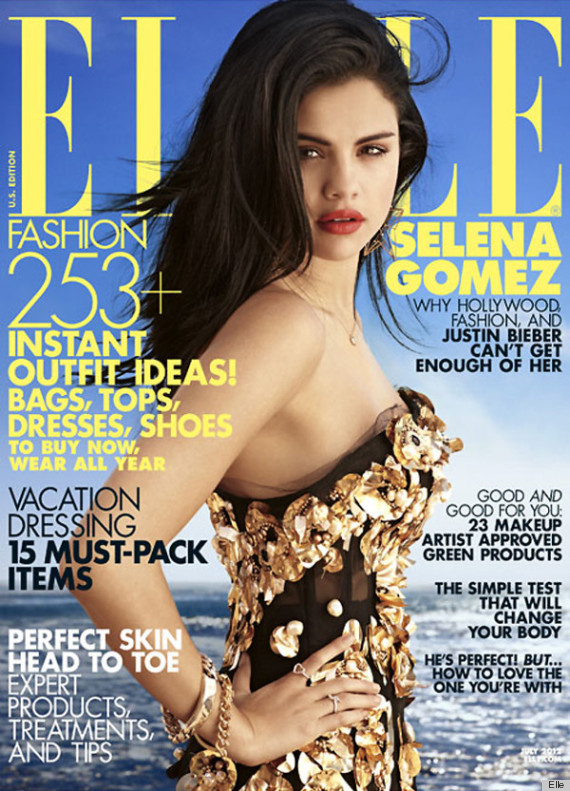
BEAUTIFUL PHOTO: Selena Gomez Photoshop Job

PHOTOS: Selena Gomez Photoshop Job:

Remember when Selena Gomez played a pint-size wizard in t-shirts on TV? Those days seem long past us, now that Gomez is dressing in glam gowns and cozying up to boyfriend Justin Bieber.


The 19-year-old beauty, who just launched her own fragrance, continues her arc to maturity this month, covering the July issue of Elle in red lipstick and a gilded bodysuit from Dolce & Gabbana's Fall 2012 collection (a fancy step up from some of the other outfits she's been wearing.) It's bold styling for Selena, who looks years older than she is (right?) on the Elle cover.


Gomez just released a short parody film called "Fifty Shades of Blue," but actually, we're seeing fifty shades of Photoshop on her new cover, gorgeous as it is. Is it just us, or does Gomez' head look a little pasted onto her body? There's a strange demarcation line between her chin and her neck, and both areas look like they're different colors.


But hey, that's just our .02. Scope out the cover and vote below!


selena gomez elle

See some more obvious Photoshop fails!


Want more? Be sure to check out HuffPost Style on Twitter, Facebook, Tumblr and Pinterest.

CELEBRITY NEWS
FREE MUSIC - PALCO MP3

PHOTOS: Did Kate Middleton Wear Fake Diamonds ?

PHOTOS: Did Kate Middleton Wear Fake Diamonds... To The Diamond Jubilee?:
First budget airlines, then consignment shopping. Now cubic zirconia instead of diamonds? Kate Middleton just might be the thriftiest royal ever.

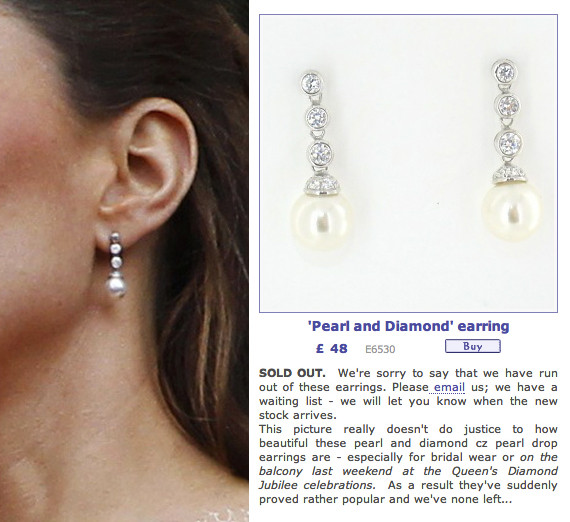
According to the Daily Mail, the Duchess of Cambridge paired her blush-colored Alexander McQueen dress from Tuesday's Jubilee celebration with "fake" earrings made of cubic zirconia and imitation pearls.

Belinda Hadden, the founder of Heavenly Necklaces, realized Catherine's diamond and pearl drop earrings were her own when a client saw Kate in the Diamond Jubilee procession earlier this week. The heralded carriage ride carried Kate, Prince William, Queen Elizabeth II and the rest of the royal gang to Buckingham Palace in honor of the Diamond Jubilee and all eyes (and cameras and film crews) were trained on Kate's outfit.

For her dress she chose McQueen, again; her hat was Jane Taylor and her clutch was Prada. As for her jewelry, Hadden tells the Daily Mail, "I had no idea Kate had worn my earrings until another client sent me an email asking: 'Are they the same as mine?'"

Apparently they are Heavenly Necklaces' "Pearl and Diamond" Earrings which retail for £48, or around $75. (WhatKateWore speculates that they are the same ones Kate wore last July when she and the queen visited her wedding dress exhibit.)

$75 for gorgeous costume jewelry? Dressing like a princess was never so easy! Alas, it seems that The Duchess Effect is still going strong: the "Pearl and Diamond" Earring is totally sold out with a waiting list.

A waiting list for cubic zirconia earrings? The powers of Kate Middleton will never cease to amaze us.

See pics of Kate's "fake earrings" below! Can you tell they're not real diamond?

kate middleton fake earrings

kate middleton fake earrings

See pics of the whole Royal Family riding in the Jubilee processional!


CELEBRITY NEWS
FREE MUSIC - PALCO MP3

GREAT PHOTO: Photoshop Fail Makes Bike Disappear

PHOTOS: Photoshop Fail Makes Bike Disappear:
Ever wondered how to make a bike disappear in New York City?

1. Leave it unattended and unlocked outside for about, oh, 2.5 seconds.

2. Hide it behind your sparkly jeggings.

At least, that second one works in the magical fairytale land of Photoshop wizardry. Our friends at Photoshop Disasters spotted this flub in a Neiman Marcus shoot for J Brand jeans that's still up on Neiman's website at the time of writing. In the pic, a model shows off her (very cute, we might add) 910 Sterling Sparkle Skinny Jeans on a sunny city block -- but wait up. Something's not quite right.

First of all, the model's right hand seems to be disappearing behind her. Fine, it could just be tucked behind her back; we'll give her the benefit of the doubt. But, there's no way the other half of that big-ass bike is hiding behind a pair of skinny jeans.

Also: who holds a bicycle like that? We'll keep scratching our heads over that mystery while you check out the offending pic and even more Photoshop fails below.

PHOTOS:

photoshop fail

See more Photoshop disasters!


Want more? Be sure to check out HuffPost Style on Twitter, Facebook, Tumblr and Pinterest.

CELEBRITY NEWS
FREE MUSIC - PALCO MP3

Germany’s “Next Top Model” - Justin Bieber Performing

Justin Bieber Performing On Germany’s “Next Top Model” June 7, 2012:

Justin Bieber just announced that he will be performing on Germany’s “Next Top Model” show tonight, June 7, 2012. Here’s the message from Justin:
Getting ready to perform #Boyfriend for you on Germany’s Next Top Model tonight. @adamlevine see you there!
Exciting! Let us know if you get to watch the performance!
P.S. We can’t wait for Justin’s “Justin Bieber Believe: All Around The WorldTV special to air on NBC on June 21, 2012 so we can see all of the performances Justin has been doing out of the country!

CELEBRITY NEWS
FREE MUSIC - PALCO MP3