The Rolling Stones
Background information
Origin London, England
Genres Rock, rock and roll, rhythm and blues, blues
Years active 1962-present
Labels Decca, London, Rolling Stones, Virgin, ABKCO, Interscope, Polydor
Website
http://www.RollingStones.com
USA Fashion & Music News
Rolling Stones Biography & Pictures
http://thefireboys.blogspot.com/2010/03/rolling-stones-photos-biography.html
Members
Mick Jagger
Keith Richards
Ronnie Wood
Charlie Watts
Former members
Brian Jones
Ian Stewart
Dick Taylor
Mick Taylor
Bill Wyman
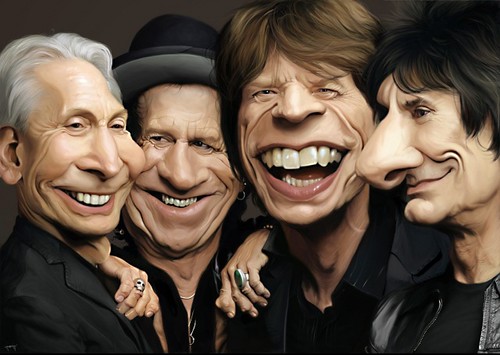
The Rolling Stones are an English rock band, formed in 1962 in London when guitarist and harmonica player Brian Jones and pianist Ian Stewart were joined by vocalist Mick Jagger and guitarist Keith Richards. Bassist Bill Wyman and drummer Charlie Watts completed the early lineup. Stewart, deemed unsuitable as a teen idol, was removed from the official lineup in 1963 but continued as the band's road manager and occasional keyboardist until his death in 1985. After signing to Decca Records in 1963, the spelling of their name changed from "the Rollin' Stones" to "the Rolling Stones."
In 1963 Jagger and Richards formed a songwriting partnership and eventually took over leadership of the band as Jones became increasingly troubled and erratic. After recording mainly covers of American blues and R&B songs, every studio record since the 1966 album Aftermath has featured mainly Jagger/Richards songs. Mick Taylor replaced Jones shortly before Jones's death in 1969. Taylor quit in 1974, and was replaced in 1975 by Faces guitarist Ronnie Wood, who has remained with the band ever since. Wyman left the Rolling Stones in 1992, and Darryl Jones, who is not an official band member, has been the primary bassist since 1994.
First popular in the UK, The Rolling Stones toured the US repeatedly during the early 1960s "British Invasion". The Rolling Stones have released 22 studio albums in the UK (24 in the US), eight concert albums (nine in the US) and numerous compilations; and have album sales estimated at more than 200 million worldwide. Sticky Fingers (1971) began a string of eight consecutive studio albums reaching number one in the United States. Their latest album, A Bigger Bang, was released in 2005. In 1989 The Rolling Stones were inducted into the Rock and Roll Hall of Fame, and in 2004 they ranked number 4 in Rolling Stone magazine's 100 Greatest Artists of All Time. In 2008, Billboard magazine ranked The Rolling Stones at number ten on "The Billboard Hot 100 Top All-Time Artists", making them as the second most successful group in the history of Billboard Hot 100 chart.
Contents
1 History
1.1 Early history
1.2 1962-64
1.3 1965-69
1.4 1970-74
1.5 1975-82
1.6 1983-91
1.7 1992-2004
1.8 Since 2005
2 Musical evolution
2.1 Infusion of American blues
2.2 Early songwriting
3 Band members
3.1 Line-ups
4 Discography
5 Concert tours
6 Official videography
==History==
==Early history==
In the early 1950s Keith Richards and Mick Jagger were classmates at Wentworth Primary School in Dartford, Kent. They met again in 1960 while Richards was attending Sidcup Art College. Richards recalled, "I was still going to school, and he was going up to the London School of Economics... So I get on this train one morning, and there's Jagger and under his arm he has four or five albums... He's got Chuck Berry and Muddy Waters". With mutual friend Dick Taylor (later of Pretty Things), they formed the band Little Boy Blue and the Blue Boys. Stones founders Brian Jones and pianist Ian Stewart were active in the nascent London R&B scene fostered by Cyril Davies and Alexis Korner. Jagger and Richards met Jones while he was playing slide guitar sitting in with Korner's Blues Incorporated. Korner also had hired Jagger periodically and frequently future Stones drummer Charlie Watts. Richards credits Stewart with instigating and finding a space for rehearsals. The early rehearsals included Stewart, Jones, Jagger and Richards, as well as guitarist Geoff Bradford and vocalist Brian Knight. The latter two objected to the Chuck Berry material that Jagger and Richards favoured, and ended their involvement with the as-yet-unnamed band. In June 1962 the lineup was: Jagger, Richards, Stewart, Jones, Taylor, and drummer Tony Chapman. Taylor then left the group. According to Richards, Jones christened the band in a "panic" while phoning Jazz News to place an advertisement. When asked what the band's name was, Jones glanced at a Muddy Waters LP lying on the floor; one of the tracks was "Rollin' Stone".
1962-64
On 12 July 1962 the group played their first formal gig at the Marquee Club, billed as "The Rollin' Stones". The line-up was Jagger, Richards, Jones, Stewart on piano, Taylor on bass and Tony Chapman on drums. Jones and Stewart intended to play primarily Chicago blues, but were agreeable the Chuck Berry and Bo Diddley numbers Jagger and Richards brought to the band. Bassist Bill Wyman joined in December and drummer Charlie Watts the following January to form the band's long-standing rhythm section.
Acting Rolling Stones' manager Giorgio Gomelsky booked them for what became an eight-month Sunday residency at The Crawdaddy Club - named after the bands' 20-minute version of Bo Diddley's "Doin' the Crawdad" which they often closed with. First located at the Station Hotel in Richmond , the Crawdaddy Club moved to the larger Richmond Athletic Association. Gomelsky paired the Rolling Stones' residency at the club with the emergence of The Beatles as key events for "Swinging London" in which the blues enjoyed an international renaissance.
In March 1963 engineer Glyn Johns arranged an agreement with The Rollling Stones and IBC Studios for the band's very first recording session. In exchange for three hours of studio time, Jones signed on the band's behalf a recording contract with IBC. The session produced a four-cut demo featuring two Bo Diddley songs, "Diddley Daddy" and "Road-Runner", as well as Muddy Waters's "I Want to be Loved" and Jimmy Reed's "Honey, What's Wrong?". Later, on the eve of signing to Decca Records, Jones feigned that he was leaving the band and paid 90 pounds cash which he was provided with to buy out the IBC contact.
Tipped off by Record Mirror journalist Peter Jones about the large and fashionable Crawdaddy audiences, former Beatles publicist, Andrew Loog Oldham, became the Rolling Stones manager in April, 1963. Oldham's age of nineteen - besides making him younger than any of the band members - made him ineligible for an agent's license. To make matters legal, in May of 1963 Oldham became co-manager of the band with veteran booker Eric Easton, as Mrs. Oldham signed the agreement for her underage son. Gomelsky had no written agreement with the band and was not consulted.
Oldham and Easton got the Rolling Stones signed to Decca by AR rep Dick Rowe who, subsequent to becoming known for rejecting the Beatles, courted the Rolling Stones based on Beatle George Harrison's solicited recommendation. Desperate to bring the Rolling Stones to Decca, Rowe signed the band through Oldham and Eastons' production company Impact Sound, after an attempt to record the band at Decca's West Hampstead studios without Oldham's involvement ended in failure. The three year Impact Sound agreement committed The Rolling Stones to Decca and gave them three times the royalty rate of an average recording act under a tape-lease agreement that gave the band artistic control of their recordings, ownership of the recording masters, which they leased to Decca, and Oldham was also allowed his choice of recording studios. All of these were favourable terms which, at the time, were unusual in England". Despite having almost no recording-studio experience, Oldham made himself the band's producer and booked the band into independent studios such as Olympic, De Lane Lea and Regent Sound.
Besides earning better royalty rates through using independent studios, the band found avoiding any major studio artistically conducive. After finding the stereo four-track facilities of Olympic to be unnerving, in late 1963 and early 1964 Oldham and the Rolling Stones settled on Regent Sound, a relatively primitive and inexpensive monophonic demo facility on Denmark Street, with egg boxes on the ceiling for sound treatment. All tracks for the first album were recorded at Regent, where noted Oldham, "The sound leaked, instrument to instrument, the right way" creating a "wall of noise" in mono that suited the band's sound. Because at Regent the band could record for extended intervals, they could create and experiment without possible interference from Decca A&R.
Recording at independent studios also let Oldham present The Rolling Stones as stars, who, unlike the Beatles, were not "mere motals...sweating in the studio for the man", as Oldham developed his media strategy to contrast The Rolling Stones as the nasty opposites of the Beatles. How The Rolling Stones were perceived was important to Oldham: he changed the spelling of the band from "the Rollin' Stones" to "the Rolling Stones" and changed the spelling of Richards last name to Richard because it "looked more pop". He also had Stewart, who did not fit Oldham's mold of "pretty, thin, long-haired boys", removed from band photos and live appearances to become the band's road manager and occasional studio pianist. To exploit the media Oldham learned to take advantage of what the band offered. According to Wyman: "Our reputation and image as the Bad Boys came later, completely accidentally. Andrew never did engineer it. He simply exploited it exhaustively." In fact, before reversing course, Oldham initially tried to make the band more presentable with identical suits, but acquiesced as the band gradually returned to wearing their own clothes for public appearances.
The Rolling Stones in the 1960s. From left: Jagger, Jones, Richards, Wyman and WattsThe Rolling Stones' first single, recorded during an unhappy session at Olympic Studios during contract negotiations as an audition of sorts, was released with the A-side(released 7 June 1963) being a cover of Chuck Berry's "Come On". Though The Rolling Stones appeared on the TV show "Thank Your Luck Stars" playing "Come On",, they disliked the song and refused to play it at live gigs. Decca also did little to promote "Come On". Oldham, aware of how unimpressive "Come On" was, still feared that if the record did poorly, Decca would neglect the band and not allow any other record company to sign them. Oldham's response was to dispatch fan club members to buy copies at record shops specifically chosen because they were polled by the charts. After the release of "Come On" the band began touring, playing their first gig outside greater London at the Outlook Club in Middlesbrough on 13 July. Later in the year Oldham and Easton booked the band on their first big UK concert tour, as a supporting act for American stars including Bo Diddley, Little Richard and The Everly Brothers. The autumn 1963 tour became a "training ground" for the young band's stagecraft.
During this tour the Rolling Stones recorded their second single, a Lennon/McCartney-penned number entitled "I Wanna Be Your Man; it reached number 12 in the UK charts. Their third single featured Buddy Holly's "Not Fade Away" , released in February of 1964, and reached number 3.
Oldham believed that recording songs written by "middle-aged blacks", besides giving away revenue to artists he did not represent, could also limit the band's appeal to its teenage audience. At Oldham's direction, Jagger and Richards began to co-write songs, the first batch of which he described as "soppy and imitative." Because songwriting developed slowly, songs on the band's first album The Rolling Stones, (issued in the US as England's Newest Hit Makers) were primarily covers, with only one Jagger/Richards original "Tell Me (You're Coming Back)" and two numbers credited to Nanker Phelge, the pen name for songs written by the entire group.
The Rolling Stones' first US tour, in June 1964, was, in Bill Wyman's words, "a disaster. When we arrived, we didn't have a hit record or anything going for us." When the band appeared on Dean Martin's TV variety show The Hollywood Palace, Martin mocked both their hair and their performance. During the tour recorded for two days at Chess Studios in Chicago, meeting many of their most important influences, including Muddy Waters. These sessions included what would become The Rolling Stones' first number 1 hit in the UK: their cover of Bobby and Shirley Womack's "It's All Over Now".
"The Stones" followed James Brown in the filmed theatrical release of The TAMI Show, which showcased American acts with British Invasion artists. According to Jagger in 2003, "We weren't actually following James Brown because there were hours in between the filming of each section. Nevertheless, he was still very annoyed about it..." On 25 October the band also appeared on The Ed Sullivan Show. Sullivan, reacting to the pandemonium the Stones caused, stated he would never book them again, though he later did book them repeatedly. Their second LP the US-only 12 X 5 was released during this tour; like their first album, it contained mainly cover tunes, augmented by Jagger/Richards and Nanker Phelge tracks.
The Rolling Stones' fifth UK single a cover of Willie Dixon's "Little Red Rooster" backed by "Off the Hook" (Nanker Phelge) was released in November 1964 and became their second number-1 hit in the UK an unprecedented achievement for a blues number. The band's US distributors (London Records) declined to release "Little Red Rooster" as a single there. In December 1964 London Records released the band's first single with Jagger/Richards originals on both sides: "Heart of Stone" backed with "What a Shame"; "Heart of Stone" went to number 19 in the US.
1965-69
The band's second UK LP - The Rolling Stones No. 2, released in January 1965 - was another number 1 on the album charts; the US version, released in February as The Rolling Stones, Now!, went to number 5. Most of the material had been recorded at Chess Studios in Chicago and RCA Studios in Los Angeles. In January/February 1965 the band also toured Australia and New Zealand for the first time, playing 34 shows for about 100,000 fans.
The first Jagger/Richards composition to reach number 1 on the UK singles charts was "The Last Time" (released in February 1965); it went to number 9 in the US. It was also later identified by Richards as the "the bridge to into thinking about writing for The Stones. It gave us a level of confidence; a pathway of how to do it." Their first international number-1 hit was "(I Can't Get No) Satisfaction", recorded in May 1965 during the band's third North American tour. In recording the guitar riff with the fuzzbox that drives the song, Richards had envisoned it as a scratch track to guide a horn section. Disagreeing, Oldham released "Satisfaction" without the planned horn overdubs. Issued in the US in June 1965, it spent four weeks at the top of the charts there, establishing the Stones as a worldwide premier act.
The US version of the LP Out of Our Heads (released in July 1965) also went to number 1; it included seven original songs (three Jagger/Richards numbers and four credited to Nanker Phelge). Their second international number-1 single, "Get Off of My Cloud" was released in the autumn of 1965, followed by another US-only LP: December's Children.
Aftermath (UK number 1; US 2), released in the late spring of 1966, was the first Rolling Stones album to be composed entirely of Jagger/Richards songs. On this album Jones's contributions expanded beyond guitar and harmonica. To the Middle Eastern-influenced "Paint It Black" he added sitar, to the ballad "Lady Jane" he added dulcimer, and to "Under My Thumb" he added marimbas. Aftermath was also notable for the almost 12-minute long "Goin' Home", the first extended jam on a top-selling rock & roll album.
The Stones' success on the British and American singles charts peaked during 1966. "19th Nervous Breakdown" (Feb. 1966, UK number 2, US number 2) was followed by their first trans-Atlantic number-1 hit "Paint It Black" (May 1966). "Mother's Little Helper" (June 1966) was only released as a single in the USA, where it reached number 8; it was one of the first pop songs to address the issue of prescription drug abuse. Notably, Jagger sang the lyric in his natural London accent, rather than his usual affected southern American accent.
The September 1966 single "Have You Seen Your Mother, Baby, Standing In The Shadow?" (UK number 5, US number 9) was notable in several respects: It was the first Stones recording to feature brass horns, the (now-famous) back-cover photo on the original US picture sleeve depicted the group satirically dressed in drag, and the song was accompanied by one of the first purposely-made promotional film clips (music videos), directed by Peter Whitehead.
January 1967 saw the release of Between the Buttons (UK number 3; US 2); the album was Andrew Oldham's last venture as The Rolling Stones' producer (his role as the band's manager had been taken over by Allen Klein in 1965). The US version included the double A-side single "Let's Spend the Night Together" and "Ruby Tuesday", which went to number 1 in America and number 3 in the UK. When the band went to New York to perform the numbers on The Ed Sullivan Show, they were ordered to change the lyrics of the refrain to "let's spend some time together".
Jagger, Richards and Jones began to be hounded by authorities over their recreational drug use in early 1967, after News of the World ran a three-part feature entitled "Pop Stars and Drugs: Facts That Will Shock You". The series described alleged LSD parties hosted by The Moody Blues and attended by top stars including The Who's Pete Townshend and Cream's Ginger Baker, and alleged admissions of drug use by leading pop musicians. The first article targeted Donovan (who was raided and charged soon after); the second installment (published on 5 February) targeted the Rolling Stones. A reporter who contributed to the story spent an evening at the exclusive London club Blaise's, where a member of the Stones allegedly took several Benzedrine tablets, displayed a piece of hashish and invited his companions back to his flat for a "smoke". The article claimed that this was Mick Jagger, but it turned out to be a case of mistaken identity the reporter had in fact been eavesdropping on Brian Jones. On the night the article was published Jagger appeared on the Eammon Andrews chat show and announced that he was filing a writ of libel against the paper.
A week later on Sunday 12 February, Sussex police (tipped off by the News of the World) raided a party at Keith Richards's home, Redlands. No arrests were made at the time but Jagger, Richards and their friend Robert Fraser (an art dealer) were subsequently charged with drug offences. Richards said in 2003, "When we got busted at Redlands, it suddenly made us realise that this was a whole different ball game and that was when the fun stopped. Up until then it had been as though London existed in a beautiful space where you could do anything you wanted."
In March, while awaiting the consequences of the police raid, Jagger, Richards and Jones took a short trip to Morocco, accompanied by Marianne Faithfull, Jones's girlfriend Anita Pallenberg and other friends. During this trip the stormy relations between Jones and Pallenberg deteriorated to the point that Pallenberg left Morocco with Richards. Richards said later: "That was the final nail in the coffin with me and Brian. He'd never forgive me for that and I don't blame him, but hell, shit happens." Richards and Pallenberg would remain a couple for twelve years. Despite these complications, The Rolling Stones toured Europe in March and April 1967. The tour included the band's first performances in Poland, Greece and Italy.
On 10 May 1967 the same day Jagger, Richards and Fraser were arraigned in connection with the Redlands charges Brian Jones's house was raided by police and he was arrested and charged with possession of cannabis. Three out of five Rolling Stones now faced criminal charges. Jagger and Richards were tried at the end of June. On 29 June Jagger was sentenced to three months' imprisonment for possession of four amphetamine tablets; Richards was found guilty of allowing cannabis to be smoked on his property and sentenced to one year in prison. Both Jagger and Richards were imprisoned at that point, but were released on bail the next day pending appeal. The Times ran the famous editorial entitled "Who breaks a butterfly on a wheel?" in which editor William Rees-Mogg was strongly critical of the sentencing, pointing out that Jagger had been treated far more harshly for a minor first offence than "any purely anonymous young man".
While awaiting the appeal hearings, the band recorded a new single, "We Love You", as a thank-you for the loyalty shown by their fans. It began with the sound of prison doors closing, and the accompanying music video included allusions to the trial of Oscar Wilde. On 31 July, the appeals court overturned Richards's conviction, and Jagger's sentence was reduced to a conditional discharge. Brian Jones's trial took place in November 1967; in December, after appealing the original prison sentence, Jones was fined £1000, put on three years' probation and ordered to seek professional help.
December 1967 also saw the release of Their Satanic Majesties Request (UK number 3; US 2), released shortly after The Beatles' Sgt. Pepper's Lonely Hearts Club Band. Satanic Majesties had been recorded in difficult circumstances while Jagger, Richards and Jones were dealing with their court cases. The band parted ways with producer Andrew Oldham during the sessions. The split was amicable, at least publicly, but in 2003 Jagger said: "The reason Andrew left was because he thought that we weren't concentrating and that we were being childish. It was not a great moment really - and I would have thought it wasn't a great moment for Andrew either. There were a lot of distractions and you always need someone to focus you at that point, that was Andrew's job."
Satanic Majesties thus became the first album The Rolling Stones produced on their own. It was also the first of their albums released in identical versions on both sides of the Atlantic. Its psychedelic sound was complemented by the cover art, which featured a 3D photo by Michael Cooper, who had also photographed the cover of Sgt. Pepper. Bill Wyman wrote and sang a track on the album: "In Another Land", which was also released as a single, the first on which Jagger did not sing lead vocal.
The band spent the first few months of 1968 working on material for their next album. Those sessions resulted in the song "Jumpin' Jack Flash", released as a single in May. The song and the subsequent album, Beggars Banquet (UK number 3; US 5), an eclectic mix of country and blues-inspired tunes, marked the band's return to their roots, and the beginning of their collaboration with producer Jimmy Miller. Featuring the lead single "Street Fighting Man" (which addressed the political upheavals of May 1968) and the opening track "Sympathy for the Devil", Beggars Banquet was hailed as an achievement for the Stones at the time of release. On the musical evolution between albums, Richards said, "There is a change between material on Satanic Majesties and Beggars Banquet. I'd grown sick to death of the whole Maharishi guru shit and the beads and bells. Who knows where these things come from, but I guess was a reaction to what we'd done in our time off and also that severe dose of reality. A spell in prison... will certainly give you room for thought... I was fucking pissed with being busted. So it was, 'Right we'll go and strip this thing down.' There's a lot of anger in the music from that period." Richards started using open tunings for rhythm parts (often in conjunction with a capo), most prominently an open-E or open-D tuning in 1968. Beginning in 1969, he often used 5-string open-G tuning (with the lower 6th string removed), as heard on the 1969 single "Honky Tonk Women", "Brown Sugar" (Sticky Fingers, 1971), "Tumbling Dice"(capo IV), "Happy"(capo IV) (Exile on Main St., 1972), and "Start Me Up" (Tattoo You, 1981).
The end of 1968 saw the filming of The Rolling Stones Rock and Roll Circus. It featured John Lennon, Yoko Ono, The Dirty Mac, The Who, Jethro Tull, Marianne Faithfull and Taj Mahal. The footage was shelved for twenty-eight years but was finally released officially in 1996.
By the release of Beggars Banquet, Brian Jones was increasingly troubled and was only sporadically contributing to the band. Jagger said that Jones was "not psychologically suited to this way of life". His drug use had become a hindrance, and he was unable to obtain a US visa. Richards reported that, in a June meeting with Jagger, Richards, and Watts at Jones's house, Jones admitted that he was unable to "go on the road again". According to Richards, all agreed to let Jones "...say I've left, and if I want to I can come back". His replacement was the 20-year-old guitarist Mick Taylor, of John Mayall's Bluesbreakers, who started recording with the band immediately. On 3 July 1969, less than a month later, Jones drowned in the swimming pool at his Cotchford Farm home in Sussex.
1970-74
Richards on stage in 1972The Rolling Stones were scheduled to play at a free concert in London's Hyde Park two days after Brian Jones's death; they decided to proceed with the show as a tribute to Jones. The concert, their first with Mick Taylor, was performed in front of an estimated 250,000 fans. The performance was filmed by a Granada Television production team, and was shown on British television as Stones in the Park. Jagger read an excerpt from Percy Bysshe Shelley's elegy Adonais and released thousands of butterflies in memory of Jones. The show included the concert debut of "Honky Tonk Women", which the band had just released. Their stage manager Sam Cutler introduced them as "the greatest rock & roll band in the world" - a description he repeated throughout their 1969 US tour, and which has stuck to this day.
The release of Let It Bleed (UK number 1; US 3) came in December. Their last album of the sixties, Let It Bleed featured "Gimmie Shelter" (with backing vocals by female vocalist Merry Clayton), "You Can't Always Get What You Want", "Midnight Rambler", as well as a cover of Robert Johnson's "Love in Vain". Jones and Taylor are featured on two tracks each. Many of these numbers were played during the band's US tour in November 1969, their first in three years. Just after the tour the band performed at the Altamont Free Concert at the Altamont Speedway, about 60 km east of San Francisco. The biker gang Hells Angels provided security, and a fan, Meredith Hunter, was stabbed and beaten to death by the Angels. Part of the tour and the Altamont concert were documented in Albert and David Maysles' film Gimme Shelter. As a response to the growing popularity of bootleg recordings, the album Get Yer Ya-Yas Out! (UK 1; US 6) was released in 1970; it was declared by critic Lester Bangs to be the best live album ever.
At the turn of the decade the band appeared on the BBC's highly rated review of the sixties music scene Pop Go The Sixties, performing Gimme Shelter on the show, which was broadcast live on 1 January 1970. Later in 1970 the band's contracts with both Allen Klein and Decca Records ended, and amid contractual disputes with Klein, they formed their own record company, Rolling Stones Records. Sticky Fingers (UK number 1; US 1), released in March 1971, the band's first album on their own label, featured an elaborate cover design by Andy Warhol. The album contains one of their best known hits, "Brown Sugar", and the country-influenced "Wild Horses". Both were recorded at Alabama's Muscle Shoals Sound Studio during the 1969 American tour. The album continued the band's immersion into heavily blues-influenced compositions. The album is noted for its "loose, ramshackle ambience" and marked Mick Taylor's first full release with the band.
Mick Taylor, playing slide guitar on his Les Paul guitar with the Stones, 1972Following the release of Sticky Fingers, The Rolling Stones left England on the advice of financial advisors. The band moved to the South of France, where Richards rented the Villa Nellcôte and sublet rooms to band members and entourage. Using the Rolling Stones Mobile Studio, they held recording sessions in the basement; they completed the resulting tracks, along with material dating as far back as 1969, at Sunset Studios in Los Angeles. The resulting double album, Exile on Main St. (UK number 1; US 1), was released in May 1972. Given an A+ grade by critic Robert Christgau and disparaged by Lester Bangs who reversed his opinion within months -- Exile is now accepted as one of the Stones' best albums. The films Cocksucker Blues (never officially released) and Ladies and Gentlemen: The Rolling Stones (released in 1974) document the subsequent highly publicised 1972 North American ("STP") Tour, with its retinue of jet-set hangers-on, including writer Terry Southern.
In November 1972, the band began sessions in Kingston, Jamaica, for their follow-up to Exile, Goats Head Soup (UK 1; US 1) (1973). The album spawned the worldwide hit "Angie", but proved the first in a string of commercially successful but tepidly received studio albums. The sessions for Goats Head Soup led to a number of outtakes, most notably an early version of the popular ballad "Waiting on a Friend", not released until Tattoo You eight years later.
The making of the record was interrupted by another legal battle over drugs, dating back to their stay in France; a warrant for Richards's arrest had been issued, and the other band members had to return briefly to France for questioning. This, along with Jagger's convictions on drug charges (in 1967 and 1970), complicated the band's plans for their Pacific tour in early 1973: they were denied permission to play in Japan and almost banned from Australia. This was followed by a European tour (bypassing France) in September/October 1973 - prior to which Richards had been arrested once more on drug charges, this time in England.
The band went to Musicland studios in Munich to record their next album, 1974's It's Only Rock 'n' Roll (UK 2; US 1), but Jimmy Miller, who had drug abuse issues, was no longer producer. Instead, Jagger and Richards assumed production duties and were credited as "the Glimmer Twins". Both the album and the single of the same name were hits.
Near the end of 1974, Taylor began to lose patience. The band's situation made normal functioning complicated, with band members living in different countries and legal barriers restricting where they could tour. In addition, drug use was affecting Richards's creativity and productivity, and Taylor felt some of his own creative contributions were going unrecognized. At the end of 1974, with a recording session already booked in Munich to record another album, Taylor quit The Rolling Stones. Taylor said in 1980, "I was getting a bit fed up. I wanted to broaden my scope as a guitarist and do something else... I wasn't really composing songs or writing at that time. I was just beginning to write, and that influenced my decision... There are some people who can just ride along from crest to crest; they can ride along somebody else's success. And there are some people for whom that's not enough. It really wasn't enough for me."
1975-82
Ronnie Wood (left) and Mick Jagger (right), during the 1975 Tour of the AmericasThe Stones used the recording sessions in Munich to audition replacements for Taylor. Guitarists as stylistically disparate as Humble Pie lead Peter Frampton and ex-Yardbirds virtuoso Jeff Beck were auditioned. Rory Gallagher and Shuggie Otis also dropped by the Munich sessions. American session players Wayne Perkins and Harvey Mandel also appeared on much of the next album, Black and Blue (UK 2; US 1) (1976). Yet Richards and Jagger also wanted the Stones to remain purely a British band. When Ronnie Wood auditioned, everyone agreed that he was the right choice. Wood had already recorded and played live with Richards, and had contributed to the recording and writing of the track "It's Only Rock 'n Roll". Though he had earlier declined Jagger's offer to join the Stones, because of his ties to the The Faces, Wood committed to the Stones in 1975 for their upcoming Tour of the Americas. He officially joined the band the following year, as the Faces dissolved. Unlike the other band members, however, Wood was a salaried employee and remained so until Wyman's departure nearly two decades later, when Wood finally became a full member of the Rolling Stones' partnership.
The 1975 Tour of the Americas kicked off in New York City with the band performing on a flatbed trailer being pulled down Broadway. The tour featured stage props including a giant phallus and a rope on which Jagger swung out over the audience.
Toronto's El Mocambo Club where part of Love You Live was recorded.Jagger had booked live recording sessions at the El Mocambo club in Toronto to balance a long-overdue live album, 1977's Love You Live (UK 3; US 5), the first Stones live album since 1970's Get Yer Ya-Ya's Out!. Richards's addiction to heroin delayed his arrival in Toronto; the other members had already assembled, awaiting Richards, and sent him a telegram asking him where he was. On 24 February 1977, when Richards and his family flew in from London, they were temporarily detained by Canada Customs after Richards was found in possession of a burnt spoon and hash residue. Three days later, the Royal Canadian Mounted Police, armed with an arrest warrant for Pallenberg, discovered "22 grams of heroin" in Richards's room. Richards was charged with importing narcotics into Canada, an offense that carried a minimum seven-year sentence. Later the Crown prosecutor conceded that Richards had procured the drugs after arrival. Despite the arrest, the band played two shows in Toronto, only to raise more controversy when Margaret Trudeau, then-wife of Canadian Prime Minister Pierre Trudeau, was seen partying with the band after one show. The band's two shows were not advertised to the public. Instead, the El Mocambo had been booked for the entire week by April Wine for a recording session. 1050 CHUM, a local radio station, ran a contest for free tickets to see April Wine. Contest winners who selected tickets for Friday or Saturday night were surprised to find that the Stones were playing.
On 4 March, Richards's partner Anita Pallenberg pled guilty to drug possession and incurred a fine in connection with the original airport incident. The drug case against Richards dragged on for over a year. Ultimately, Richards received a suspended sentence and was ordered to play two free concerts for the CNIB in Oshawa; both shows featured the Rolling Stones and The New Barbarians, a group that Wood had put together to promote his latest solo album, and which Richards also joined. This episode strengthened Richards's resolve to stop using heroin. It also contributed to the end of his relationship with Pallenberg, which had become strained since the death of their third child (an infant son named Tara). In addition, Pallenberg was unable to curb her heroin addiction while Keith struggled to get clean. While Richards was settling his legal and personal problems, Jagger continued his jet-set lifestyle. He was a regular at New York's Studio 54 disco club, often in the company of model Jerry Hall. His marriage to Bianca Jagger ended in 1978, although they had long been estranged.
Although The Rolling Stones remained popular through the first half of the 1970s, music critics had grown increasingly dismissive of the band's output, and record sales failed to meet expectations. By the late 70s, after punk rock became influential, many criticised the Stones as decadent, aging millionaires and their music as stagnant or irrelevant. This changed in 1978, after the band released Some Girls (UK #2; US #1), which included the hit single "Miss You", the country ballad "Far Away Eyes", "Beast of Burden", and "Shattered". In part as a response to punk, many songs were fast, basic, guitar-driven rock and roll, and the album's success re-established the Rolling Stones' immense popularity among young people. Following the US Tour 1978, the band guested on the first show of the fourth season of the TV series "Saturday Night Live". The group did not tour Europe the following year, breaking the routine of touring Europe every three years that the band had followed since 1967.
Following the success of Some Girls, the band released their next album Emotional Rescue (UK 1; US 1) in mid-1980. The recording of the album was reportedly plagued by turmoil, with Jagger and Richards' relationship reaching a new low. Richards, though still using heroin according to keyboardist Ian Mclagan, began to assert more control in the studio more than Jagger had become used to and a struggle ensued as Richards felt he was fighting for "his half of the Glimmer Twins." Emotional Rescue hit the top of the charts on both sides of the Atlantic and the title track reached #3 in the US.
In early 1981, the group reconvened and decided to tour the US that year, leaving little time to write and record a new album, as well as rehearse for the tour. That year's resulting album, Tattoo You (UK 2; US 1) featured a number of outtakes, including lead single "Start Me Up", which reached #2 in the US and ranked #22 on Billboard's Hot 100 year-end chart. Two songs ("Waiting on a Friend" (US #13) and "Tops") featured Mick Taylor's guitar playing, while jazz saxophonist Sonny Rollins played on "Slave" and dubbed a part on "Waiting on a Friend". The Rolling Stones scored one more Top Twenty hit on the Billboard Hot 100 in 1982, the #20 hit "Hang Fire". The Stones' American Tour 1981 was their biggest, longest and most colourful production to date, with the band playing from 25 September through 19 December. It was the highest grossing tour of that year. Some shows were recorded, resulting in the 1982 live album Still Life (American Concert 1981) (UK 4; US 5), and the 1983 Hal Ashby concert film Let's Spend the Night Together, which was filmed at Sun Devil Stadium in Phoenix, Arizona and the Brendan Byrne Arena in the Meadowlands, New Jersey.
In mid-1982, to commemorate their 20th anniversary, the Stones took their American stage show to Europe. The European Tour 1982 was their first European tour in six years. The tour was essentially a carbon copy of the 1981 American tour. For the tour, the band were joined by former Allman Brothers Band piano player Chuck Leavell, who continues to play and record with the Stones. By the end of the year, the band had signed a new four-album, 28 million dollar recording deal with a new label, CBS Records.
1983-91
Before leaving Atlantic, the Stones released Undercover (UK 3; US 4) in late 1983. Despite good reviews and the Top Ten peak position of the title track, the record sold below expectations and there was no tour to support it. Subsequently the Stones' new marketer/distributor CBS Records took over distributing the Stones' Atlantic catalogue.
By this time, the Jagger/Richards split was growing. Much to the consternation of Richards, Jagger had signed a solo deal with CBS Records, and he spent much of 1984 writing songs for this first solo effort. He has also stated that he was feeling stultified within the framework of the Rolling Stones. By 1985, Jagger was spending more time on solo recordings, and much of the material on 1986's Dirty Work (UK #4; US #4) was generated by Keith Richards, with more contributions by Ron Wood than on previous Rolling Stones albums. Rumours surfaced that Jagger and Richards were rarely, if ever, in the studio at the same time, leaving Richards to keep the recording sessions moving forward.
In December 1985, the band's co-founder, pianist, road manager and long-time friend Ian Stewart died of a heart attack. The Rolling Stones played a private tribute concert for him at London's 100 Club in February 1986, two days before they were presented with a Grammy Lifetime Achievement Award.
Dirty Work was released in March 1986 to mixed reviews despite the presence of the US Top Five hit "Harlem Shuffle"; Jagger refused to tour to promote the album, stating later that several band members were in no condition to tour. Richards was infuriated when Jagger instead undertook his own solo tour which included Rolling Stones songs. He has referred to this period in his relations with Jagger as "World War III". Jagger's solo records, She's The Boss (UK 6; US 13) (1985) and Primitive Cool (UK 26; US 41) (1987), met with moderate success, although Richards disparaged both. Many believed the group would disband. In 1988, with the Rolling Stones inactive, Richards released his first solo album, Talk Is Cheap (UK 37; US 24). It was well received by fans and critics, going gold in the US.
In early 1989, the Rolling Stones, including Mick Taylor, Ronnie Wood and Ian Stewart (posthumously), were inducted into the American Rock and Roll Hall of Fame. Jagger and Richards set aside animosities and went to work on a new Rolling Stones album that would be called Steel Wheels (UK 2; US 3). Heralded as a return to form, it included the singles "Mixed Emotions" (US #5), "Rock and a Hard Place" (US #23) and "Almost Hear You Sigh". It also included "Continental Drift", which was recorded in Tangier in 1989 with The Master Musicians of Jajouka led by Bachir Attar.
The subsequent Steel Wheels/Urban Jungle Tours, encompassing North America, Japan and Europe, saw the Rolling Stones touring for the first time in seven years (since Europe 1982), and it was their biggest stage production to date. Opening acts included Living Colour and Guns N' Roses; the onstage personnel included a horn section and backup singers Lisa Fischer and Bernard Fowler, both of whom continue to tour regularly with the Rolling Stones. Recordings from the Steel Wheels/Urban Jungle tours produced the 1991 concert album Flashpoint (UK 6; US 16), which also included two studio tracks recorded in 1991: the single "Highwire" and "Sex Drive".
These were the last Rolling Stones tours for Bill Wyman, who left the band after years of deliberation, although his retirement was not made official until December 1992. He then published Stone Alone, an autobiography based on scrapbooks and diaries he had been keeping since the band's early days. A few years later he formed Bill Wyman's Rhythm Kings and began recording and touring again.
1992-2004
After the successes of the Steel Wheels/Urban Jungle tours, the band took a break. Charlie Watts released two jazz albums; Ronnie Wood made his fifth solo album, the first in 11 years, called Slide On This; Keith Richards released his second solo album in late 1992, Main Offender (UK 45; US 99), and did a small tour including big concerts in Spain and Argentina. Mick Jagger got good reviews and sales with his third solo album, Wandering Spirit (UK 12; US 11). The album sold more than two million copies worldwide, going gold in the US.
After Wyman's departure, the Rolling Stones' new distributor/record label, Virgin Records, remastered and repackaged the band's back catalogue from Sticky Fingers to Steel Wheels, except for the three live albums, and issued another hits compilation in 1993 entitled Jump Back (UK 16; US 30). By 1993 the Stones set upon their next studio album. Darryl Jones, former sideman of Miles Davis and Sting, was chosen by Charlie Watts as Wyman's replacement for 1994's Voodoo Lounge (UK 1; US 2). The album met strong reviews and sales, going double platinum in the US. Reviewers took note of the album's "traditionalist" sounds, which were credited to the Rolling Stones' new producer Don Was. It would go on to win the 1995 Grammy Award for Best Rock Album.
1994 also brought the accompanying Voodoo Lounge Tour, which lasted into 1995. Numbers from various concerts and rehearsals (mostly acoustic) made up Stripped (UK 9; US 9), which featured a cover of Bob Dylan's "Like A Rolling Stone", as well as infrequently played songs like "Shine a Light", "Sweet Virginia" and "The Spider and the Fly".
Keith Richards in Hannover, 2006, during the A Bigger Bang TourThe Rolling Stones ended the 1990s with the album Bridges To Babylon (UK 6; US 3), released in 1997 to mixed reviews. The video of the single "Anybody Seen My Baby?" featured Angelina Jolie as guest and met steady rotation on both MTV and VH1. Sales were reasonably equivalent to those of previous records (about 1.2 million copies sold in the US), and the subsequent Bridges to Babylon Tour, which crossed Europe, North America and other destinations, proved the band to be a strong live attraction. Once again, a live album was culled from the tour, No Security (UK 67; US 34), only this time all but two songs ("Live With Me" and "The Last Time") were previously unreleased on live albums. In 1999, the Stones staged the No Security Tour in the US and continued the Bridges to Babylon tour in Europe. The No Security Tour offered a stripped-down production in contrast to the pyrotechnics and mammoth stages of other recent tours.
In late 2001, Mick Jagger released his fourth solo album, Goddess in the Doorway (UK 44; US 39) which met with mixed reviews. Jagger and Richards took part in "The Concert for New York City", performing "Salt of the Earth" and "Miss You" with a backing band.
In 2002, the band released Forty Licks (UK 2; US 2), a greatest hits double album, to mark their forty years as a band. The collection contained four new songs recorded with the latter-day core band of Jagger, Richards, Watts, Wood, Leavell and Jones. The album has sold more than 7 million copies worldwide. The same year, Q magazine named The Rolling Stones as one of the "50 Bands To See Before You Die", and the 2002-2003 Licks Tour gave people that chance. The tour included shows in small theatres, arenas and stadiums. The band headlined the Molson Canadian Rocks for Toronto concert in Toronto, Ontario, Canada, to help the city which they have used for rehearsals since the Steel Wheels tour recover from the 2003 SARS epidemic. The concert was attended by an estimated 490,000 people.
On 9 November 2003, the band played their first concert in Hong Kong as part of the Harbour Fest celebration, also in support of the SARS-affected economy. In November 2003, the band exclusively licensed the right to sell their new four-DVD boxed set, Four Flicks, recorded on the band's most recent world tour, to the US Best Buy chain of stores. In response, some Canadian and US music retail chains (including HMV Canada and Circuit City) pulled Rolling Stones CDs and related merchandise from their shelves and replaced them with signs explaining the situation. In 2004, a double live album of the Licks Tour, Live Licks (UK 38; US 50), was released, going gold in the US.
Since 2005
Wood and Jagger onstage with the Rolling Stones in Vienna, 2006On 26 July 2005, Jagger's birthday, the band announced the name of their new album, A Bigger Bang (UK 2; US 3), their first album in almost eight years. A Bigger Bang was released on 6 September to strong reviews, including a glowing write-up in Rolling Stone magazine. The single "Streets of Love" reached the Top 15 in UK and Europe.
The album included the most controversial song from the Stones in years, "Sweet Neo Con", a criticism of American Neoconservatism from Jagger. The song was reportedly almost dropped from the album because of objections from Richards. When asked if he was afraid of political backlash such as the Dixie Chicks had endured for criticism of American involvement in the war in Iraq, Richards responded that the album came first, and that, "I don't want to be sidetracked by some little political 'storm in a teacup'."
The subsequent A Bigger Bang Tour began in August 2005, and visited North America, South America and East Asia. In February 2006, the group played the half-time show of Super Bowl XL in Detroit, Michigan. By the end of 2005, the Bigger Bang tour set a record of $162 million in gross receipts, breaking the North American mark also set by the Stones in 1994. On 18 February 2006 the band played a free concert with a claimed 1.5 million attendance at the Copacabana beach in Rio de Janeiro.
After performances in Japan, China, Australia and New Zealand in March/April 2006, the Rolling Stones tour took a scheduled break before proceeding to Europe; during this break Keith Richards was hospitalized in New Zealand for cranial surgery after a fall from a tree on Fiji, where he had been on holiday. The incident led to a six-week delay in launching the European leg of the tour. In June 2006 it was reported that Ronnie Wood was continuing his programme of rehabilitation for alcohol abuse, but this did not affect the rearranged European tour schedule. Two out of the 21 shows scheduled for July-September 2006 were later cancelled due to Mick Jagger's throat problems.
The Stones returned to North America for concerts in September 2006, and returned to Europe on 5 June 2007. By November 2006, the Bigger Bang tour had been declared the highest-grossing tour of all time, earning $437 million. The North American leg brought in the third-highest receipts ever ($138.5 million), trailing their own 2005 tour ($162 million) and the U2 tour of that same year ($138.9 million).
On 29 October and 1 November 2006, director Martin Scorsese filmed the Rolling Stones performing at New York City's Beacon Theatre, in front of an audience that included Bill and Hillary Clinton, released as the 2008 film Shine a Light; the film also features guest appearances by Buddy Guy, Jack White and Christina Aguilera. An accompanying soundtrack, also titled Shine a Light (UK 2; US 11), was released in April 2008. The album's debut at number 2 in the UK charts was the highest position for a Rolling Stones concert album since Get Yer Ya-Ya's Out! in 1970.
On 24 March 2007, the band announced a tour of Europe called the "Bigger Bang 2007" tour. 12 June 2007 saw the release of the band's second four-disc DVD set: The Biggest Bang, a seven-hour document featuring their shows in Austin, Rio de Janeiro, Saitama, Shanghai and Buenos Aires, along with extras. On 10 June 2007, the band performed their first gig at a festival in 30 years, at the Isle of Wight Festival, to a crowd of 65,000. On 26 August 2007, they played their last concert of the A Bigger Bang Tour at the O2 Arena in London, England. On 26 September 2007, it was announced The Rolling Stones had made $437 million on the A Bigger Bang Tour to list them in the latest edition of Guinness World Records.
Charlie Watts in Hannover, 2006Mick Jagger released a compilation of his solo work called The Very Best of Mick Jagger (UK 57; US 77), including three unreleased songs, on 2 October 2007. On 12 November 2007, ABKCO released Rolled Gold+: The Very Best of the Rolling Stones, a double-CD remake of the 1975 compilation Rolled Gold; the reissue went to number 26 in the UK charts.
In a 2007 interview with Mick Jagger after nearly two years of touring, Jagger refused to say when the band is going to retire: "I'm sure the Rolling Stones will do more things, more records and more tours, we've got no plans to stop any of that really. As far as I'm concerned, I'm sure we'll continue." In March 2008 Keith Richards sparked rumours that a new Rolling Stones studio album may be forthcoming, saying during an interview following the premiere of Shine a Light, "I think we might make another album. Once we get over doing promotion on this film". Drummer Charlie Watts remarked that he got ill whenever he stopped working. In July 2008 it was announced that the Rolling Stones were leaving EMI and signing with Vivendi's Universal Music, taking with them their catalogue stretching back to Sticky Fingers. New music released by the band while under this contract will be issued through Universal's Polydor label. Universal Records will hold the US rights to the pre-1994 material, while the post-1994 material will be handled by Interscope Records (once a subsidiary of Atlantic). Coincidentally, Universal Music is also the distributor for ABKCO, owners of the band's pre-Sticky Fingers releases.
In late November 2009 rumours circulated that the Rolling Stones are planning to tour in 2010.
==Musical evolution==
The Rolling Stones are notable in modern popular music for assimilating various musical genres into their recording and performance, ultimately making the styles their very own. The band's career is marked by a continual reference and reliance on musical styles like American blues, country, folk, reggae, dance; world music exemplified by the Master Musicians of Jajouka; as well as traditional English styles that use stringed instrumentation like harps. The band cut their musical teeth by covering early rock and roll and blues songs, and have never stopped playing live or recording cover songs.
==Infusion of American blues==
Jagger and Richards shared an admiration of Jimmy Reed, Muddy Waters and Little Walter, and their interest influenced Brian Jones, of whom Richards says, "He was more into T-Bone Walker and jazz-blues stuff. We'd turn him onto Chuck Berry and say, 'Look, it's all the same shit, man, and you can do it.'" Charlie Watts, a traditional jazz drummer, was also turned onto the blues after his introduction to the Stones. "Keith and Brian turned me on to Jimmy Reed and people like that. I learned that Earl Phillips was playing on those records like a jazz drummer, playing swing, with a straight four..."
Jagger, recalling when he first heard the likes of Chuck Berry, Bo Diddley, Muddy Waters, Fats Domino and other major American R&B artists, said it "seemed the most real thing" he had heard up to that point. Similarly, Keith Richards, describing the first time he listened to Muddy Waters, said it was the "most powerful music ever heard...the most expressive."
== Early songwriting==
Despite the Rolling Stones' predilection for blues and R&B numbers on their early live setlists, the first original compositions by the band reflected a more wide-ranging interest. The first Jagger/Richards single, "Tell Me (You're Coming Back)," is called by critic Richie Unterberger a "pop/rock ballad... When began to write songs, they were usually not derived from the blues, but were often surprisingly fey, slow, Mersey-type pop numbers." "As Tears Go By," the ballad originally written for Marianne Faithfull, was one of the first songs written by Jagger and Richards and also one of many written by the duo for other artists. Jagger said of the song, "It's a relatively mature song considering the rest of the output at the time. And we didn't think of it, because the Rolling Stones were a butch blues group." The Stones did later record a version which became a top five hit in the US.
On the early experience, Richards said, "The amazing thing is that although Mick and I thought these songs were really puerile and kindergarten-time, every one that got put out made a decent showing in the charts. That gave us extraordinary confidence to carry on, because at the beginning songwriting was something we were going to do in order to say to Andrew , 'Well, at least we gave it a try...'" Jagger said, "We were very pop-orientated. We didn't sit around listening to Muddy Waters; we listened to everything. In some ways it's easy to write to order... Keith and I got into the groove of writing those kind of tunes; they were done in ten minutes. I think we thought it was a bit of a laugh, and it turned out to be something of an apprenticeship for us."
The writing of the single "The Last Time," The Rolling Stones' first major single, proved a turning point. Richards called it "a bridge into thinking about writing for the Stones. It gave us a level of confidence; a pathway of how to do it." The song was based on a traditional gospel song popularised by The Staples Singers, but the Rolling Stones' number features a distinctive guitar riff (played on stage by Brian Jones).
==Band members==
== Line-ups==
1962 Mick Jagger lead vocals, harmonica, percussion
Brian Jones guitars, backing vocals, harmonica, percussion
Keith Richards guitars, backing vocals
Ian Stewart piano, percussion
with
Mick Avory drums
Tony Chapman drums
Ricky Fenson bass
Carlo Little drums
Dick Taylor bass
Bill Wyman bass
January April 1963 Mick Jagger lead vocals, harmonica, percussion
Brian Jones guitars, backing vocals, harmonica, percussion
Keith Richards guitars, backing vocals
Ian Stewart piano, percussion
Charlie Watts drums
Bill Wyman bass, backing vocals
May 1963 May 1969 Mick Jagger lead vocals, harmonica, percussion
Brian Jones guitars, backing vocals, harmonica, percussion, tamboura, sitar, dulcimer, keyboards, autoharp, brass, woodwinds, theremin
Keith Richards guitars, vocals, bass, keyboards, percussion
Charlie Watts drums, percussion
Bill Wyman bass, vocals, percussion, keyboards
May 1969 December 1974 Mick Jagger lead vocals, harmonica, keyboards, percussion, guitar
Keith Richards guitars, vocals, bass, keyboards
Mick Taylor guitars, bass, synthesizer, percussion, backing vocals
Charlie Watts drums, percussion
Bill Wyman bass, synthesizer
December 1974 May 1975 Mick Jagger - lead vocals, harmonica, keyboards, percussion, guitar
Keith Richards guitars, vocals, bass, keyboards
Charlie Watts drums, percussion
Bill Wyman bass, synthesizer
May 1975 December 1992 Mick Jagger lead vocals, harmonica, keyboards, guitar
Keith Richards guitars, vocals, bass, keyboards, percussion
Charlie Watts drums, percussion
Ronnie Wood guitars, backing vocals, bass, drums, percussion
Bill Wyman bass, synthesizer
1993–present Mick Jagger lead vocals, harmonica, percussion, guitar, bass, keyboards
Keith Richards guitars, vocals, bass, keyboards
Charlie Watts drums, percussion
Ronnie Wood guitars, backing vocals, bass
with
Darryl Jones bass
==Discography==
Further information: The Rolling Stones discography
In a career that has spanned nearly half a century, the band has released over 90 singles, more than two dozen studio albums, and numerous compilation and live albums. Ten of their studio albums are among Rolling Stone magazine's The 500 Greatest Albums of All Time, with their 1972 double album Exile on Main St. placing seventh.
==Concert tours==
Further information: Rolling Stones concerts
== Official videography==
Officially released films featuring the Rolling Stones are listed with their original release dates. (The formats mentioned are the most recent versions officially available, not necessarily the original release formats.)
1966: Charlie Is My Darling, directed by Peter Whitehead) (released on DVD in 2009 without the Rolling Stones' music)
1968: One Plus One (also titled Sympathy for the Devil), directed by Jean-Luc Godard (DVD)
1969: Stones in the Park (DVD)
1970: Gimme Shelter, directed by Albert and David Maysles (DVD/Blu-ray Disc)
1974: Ladies and Gentlemen: The Rolling Stones, directed by Rolin Binzer
1982: Rocks Off and Let's Spend the Night Together, both directed by Hal Ashby (DVD)
1984: Video Rewind (VHS)
1989: 25x5 - The Continuing Adventures of the Rolling Stones (VHS)
1992: Stones at the Max, directed by Julien Temple (DVD)
1995: The Rolling Stones: Voodoo Lounge Live (DVD)
1996: The Rolling Stones Rock and Roll Circus, directed by Michael Lindsay-Hogg (filmed in 1968) (DVD)
1998: Bridges to Babylon Tour '97-98 (DVD)
2003: Four Flicks (DVD)
2007: The Biggest Bang (DVD/Blu-ray Disc)
2008: Shine a Light, directed by Martin Scorsese, released to theaters in standard and IMAX presentations (DVD/Blu-ray Disc)
2009: Stones at the Max Remastered Edition, directed by Julien Temple (DVD/Blu-ray Disc)
TAGS : rolling stones, rolling, stones, london, england, rock, rock and roll, rhythm and blues, blues, decca, labels, virgin, abkco, interscope, polydor, mick jagger, keith richards, ronnie wood, charlie watts, brian jones, ian stewart, dick taylor, bill wyman, the rolling stones, english rock, bassist, guitarist, harmonica, vocalist, player, piano, keyboardist, decca records, songwriting, songs, darryl jones, popular, albums, concert, concert albums, us, sticky fingers, studio albums, united states, a bigger bang, rolling stone magazine, artists, billboard, group, billboard hot 100, chart, history, musical evolution, early songs, american blues, discography, videography, wentworth primary school, dartford, sidcup art college, little boy blue, pianist, drummer, muddy waters, LP, jazz news, marquee club, chicago blues, crawdaddy club, richmond, swinging london, international, ibc studios, bo diddley songs, didley daddy, road-runner, fashionable, band members, impact sound, independent studios, bad boys, olympic studios, appeal, teenage, audience, hollywood palace, ed sullivan show, single, london records, chess studios, chicago, satisfaction, get off of my cloud, paint it black, sitar, promotional, film, clips, music videos, ruby tuesday, number 1, america, satanic majesties, psychedelic, psychedelic sound, producer, jimmy miller, sympathy for the devil, beggars banquet, tumbling dice, atart me up, london's hyde park, television, granada television, production team, band, popularity, celebrity, honky tonk women, media, hell angels, tour, gimmie shelter, lady jane, waiting on a friend, musicland studios, creative, success, recording deal, grammy, lifetime, award, american rock, grammy awrad, best rock and roll, magazine, rolling stone, people, shows, rolling stones shows, guinness, world records, atlantic records, musical, styles, harmonica, lead vocals, percussion, guitars, synthesizer, rolling stones discography, dvd, blu-ray, blu-ray disc, vhs, remastered, video, photo, photos, photography, music video, blog, tour, lyrics, rolling stones tour, rolling stones album, rolling stones discography, rolling stones songs, rolling stones lyrics, rolling stones greatest hits, rolling stones wiki, rolling stones magazine,